
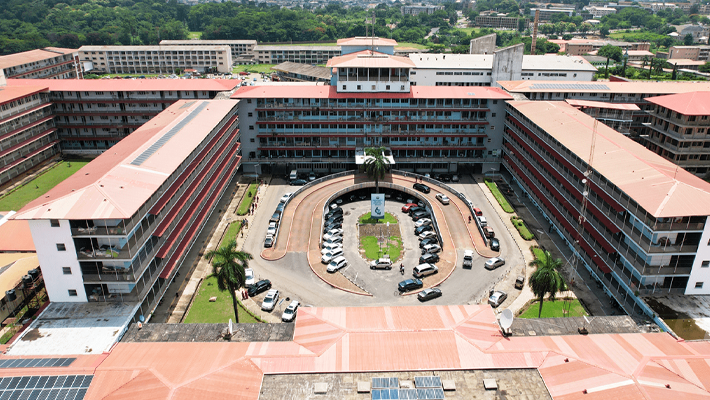
The University College Hospital (UCH), Ibadan, has stopped admitting new patients as union members embark on a five-day warning strike over a restricted power supply.
The unions include the Association of Resident Doctors (ARD), the Medical and Health Workers Union of Nigeria (MWHUN), the National Association of Nigeria Nurses and Midwives (NANNM), and the Nigerian Union of Allied Health Professionals (NUHAP), among others.
All the union members at the hospital did not work on Monday, as the strike was declared at 8.00 a.m.
The unions, under the umbrella of the Council of UCH Union Leaders (CUUL), alleged that the deliberate withholding of power crippled hospital activities, while patients suffered.
A co-chairman of CUUL, also the UCH ARD president, Uthman Adedeji, told journalists that electricity supplied to service delivery areas and residential quarters was being internally rationed and restricted by management.
He said the deliberate withholding of power crippled efficient service delivery, endangered patients, exposed staff to hazards, and undermined the hospital’s integrity.
Mr Adedeji said the restricted power supply led to the cancellation of routine surgeries and threw theatre schedules into disarray.
He expressed regret, saying, “Critical laboratory investigation results are not available to clinicians when needed, while medications, reagents, and vaccines are lost due to broken cold chains.
“Blood donors are bled under an unconducive environment; research endeavours are ground to a new halt.”
Mr Adedeji also lamented that the training of medical personnel has suffered setbacks, patients have been turned away, and life-saving equipment remains idle.
“A teaching hospital in 2026 is being forced to operate like a facility from a bygone era,” he said.
Mr Adedeji said that a huge chunk of cases and procedures presented to UCH were being rejected or referred due to inadequate internal power distribution.
“If this continues, the financial survival of UCH is at serious risk,” he said.
According to Mr Adedeji, there are also severe water shortages due to the inability to pump water, an increased risk of hospital-acquired infections, and surgeries conducted with headlamps.
“Nurses using mobile phone torch lights in wards, laboratories handling hazardous and aerosol-generating samples without functional fume cupboards.
“There is exposure to toxic and carcinogenic fumes due to inactive extraction systems, staff on night duty left in darkness, and facing security risks.
“Staff and patient relatives manually fetching water to upper floors; these are not mere inconveniences but threats to life,” he said.
He also lamented that staff living in hospital quarters faced the hardship of paying Band A electricity tariffs, plus additional charges imposed by management.
Mr Adedeji said, “Because of power restrictions, students are deprived of critical clinical exposure, essential procedures are diverted elsewhere, and research activities are severely impaired.”
The unions called for the immediate cessation of internal electricity rationing and for the full transmission of all power supplied by IBEDC to service areas and residential quarters.
They also demanded immediate restoration of the water supply across hospital facilities, hostels, and residential quarters.
They appealed to the Federal Ministry of Health, the Ministry of Power, the federal government, and well-meaning Nigerians to urgently intervene in the case to prevent further deterioration.
They called for urgent repair or replacement of all faulty prepaid meters and immediate discontinuation of arbitrary estimated billing.
Also, a co-chairman of CUUL, Oladayo Olabampe, said the unions would come back together to re-strategise on what to do next if the demands were not met.
“The strike continues till Saturday, 8:00 a.m., if nothing comes up, and we will not keep quiet after all, but may be forced to embark on an indefinite strike,” Olabampe said.