
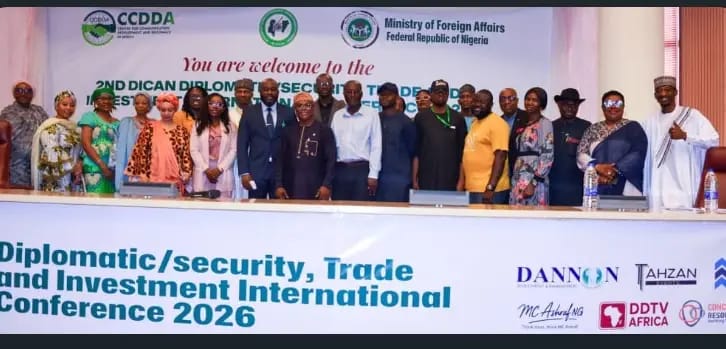
Information warfare has evolved into “highly sophisticated, industrial-scale operations” that threaten security, trade, and democratic stability, participants at the 2nd Diplomatic, Security, Trade, and Investment International Conference warned in Abuja.
The conference, convened on 20 May 2026 at the Rotunda Hall, Ministry of Foreign Affairs, was organized by the Diplomatic Correspondents’ Association of Nigeria (DICAN) in collaboration with the Centre for Communication Development and Diplomacy in Africa (CCDDA), PR Nigeria, and other partners. It was themed _“Information Warfare: Strengthening Global Security, Trade and Investment Through Collaborative Truth – The Role of Diplomacy, Intelligence and Media.”_
The gathering brought together diplomats, senior government officials, intelligence and security chiefs, private sector leaders, civil society groups, academics, and international media practitioners to address Foreign Information Manipulation and Interference (FIMI), deepfakes, and coordinated disinformation campaigns.
*Industrial-scale deception and economic fallout*
Participants observed that “information warfare has transformed from amateurish ‘fake news’ into highly sophisticated, industrial-scale operations.” According to the conference, “over 70% of FIMI campaigns now leverage generative Artificial Intelligence (AI) and high-fidelity deepfakes to simulate market crashes and manufacture diplomatic crises.”
The economic impact is significant. “Information manipulation is no longer just a political threat; it is a critical economic hazard, costing the global economy an estimated $100 billion annually in lost investments, market volatility, and diverted security expenditure.”
The threat extends to elections and social cohesion. With “over 40 nations holding major elections between 2024 and 2026, micro-targeted disinformation is being weaponized by foreign and domestic actors to hijack public opinion, distort electoral choices, and delegitimize democratic outcomes.” In Nigeria and across Africa, FIMI “has become a life-and-death issue,” with malicious actors using digital platforms “to inflame ethnic/religious tensions, disrupt regional trade blocs, and fracture long-standing diplomatic alliances.”
Despite these challenges, the conference noted positive trends in Nigeria’s trade. “Nigeria’s economic diplomacy is yielding fruits, with non-oil export values reaching a record US$6.1 billion in 2025 (an 11.5% increase over 2024), driven significantly by value-added products (51%). Protecting this investment climate requires absolute information integrity.”
*Launch of NFIIN and public campaign*
A major outcome was the launch of the Nigeria Fact-Check and Information Integrity Network (NFIIN), driven by DICAN, CCDDA, PR Nigeria, and 69 NGOs across the 36 states. NFIIN has established “six regional Situation Rooms with dedicated Desk Officers to track, verify, and counter trending falsehoods.”
The network also unveiled a tri-lingual public integrity campaign with slogans in English, Hausa, Yoruba, and Igbo: _“Verify Before You Share,” “Truth Matters: Build a Stronger, Safer Society,”_ and _“Think Before You Share.”_
Awards of Excellence were presented to distinguished champions of peace, democracy, and information integrity, including former President Goodluck Ebele Jonathan, the EU Delegation to Nigeria, National Security Adviser Mallam Nuhu Ribadu, the Nigerian Export Promotion Council, and the Institute for Peace and Conflict Resolution.
*Recommendations for action*
The conference put forward recommendations for governments, diplomats, media, security agencies, businesses, and citizens to counter coordinated falsehoods.
Governments should “treat public information integrity as a vital part of national security” by investing in civic education, digital literacy, and technology to detect AI and deepfake threats. Public institutions were urged to “share accurate, verified information quickly” since “when official channels are transparent and accessible, it leaves no room for rumor and propaganda to take hold.”
International partners were asked to “move beyond attending events to actively funding technical grants” for local journalists and researchers. Media houses were urged to “recommit to accuracy, fairness, and context” and to “actively join networks like NFIIN to verify viral content before publishing it.”
Security agencies should “find professional ways to share verified information with trusted media networks” and “pay closer attention to how local languages and closed messaging apps are being used by extremist groups.” Businesses were advised to see support for fact-checking as “a vital part of protecting the economic landscape,” while citizens were called to practice a “cognitive pause” before sharing unverified content.
*Looking ahead*
The conference expressed appreciation to the Ministry of Foreign Affairs for hosting the event. It announced that the 2027 DICAN International Conference will focus on “how information manipulation drives three intersecting global challenges: Security, Migration, and Human Trafficking, exposing how lies are weaponized to exploit the world’s most vulnerable people.”
The communiqué was signed by Mr. Idehai Frederick, Chairman, Diplomatic Correspondents’ Association of Nigeria (DICAN), and the Conference Secretariat/Communiqué Committee.