
By Cliff Stanley
Healing the wounds of electoral violence, rebuilding trust and converting a renewed mandate into inclusive development
The conclusion of the 2026 Osun State governorship election and the subsequent presentation of the Certificate of Return to Governor Ademola Adeleke “mark more than the formal confirmation of an electoral victory. They represent the beginning of a more demanding phase of democratic leadership: the transition from campaigning to governing, from partisan mobilisation to public responsibility, and from electoral competition to social reconstruction.”
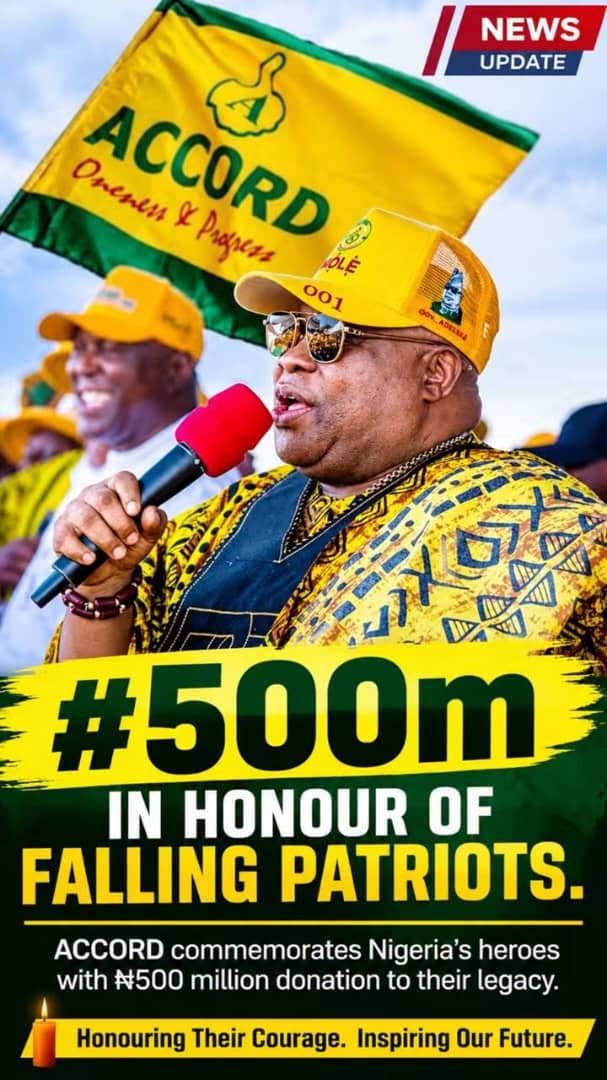
Governor Adeleke’s announcement of “a ₦500 million Election Violence Victims Endowment Fund, alongside a commitment by his family through the Springtime Development Foundation to provide scholarships up to university level for children and dependants of persons who died in election-related violence,” is therefore significant.
He has also proposed “a verification and relief mechanism chaired by the Speaker of the State House of Assembly, with an explicit commitment that assistance should be non-partisan and available irrespective of political affiliation, religion, ethnicity, gender or social status.”
“That gesture deserves recognition. But it must also be understood as the beginning not the conclusion of the state’s responsibility to heal.”
*From Campaign to Governance*
The governor has reportedly described the Certificate of Return “not as a personal trophy but as a renewed mandate from the people.” His declaration that “the election is over” and that it is now time to “govern, unite, heal and build” provides an appropriate governing philosophy for the next phase.
“But words must now become institutions, policies and measurable outcomes.”
Elections “inevitably produce winners and losers. Democracy becomes dangerous, however, when electoral defeat becomes synonymous with humiliation, exclusion or political persecution.”
Osun’s political environment has been tense. “A recent assessment by the Kimpact Development Initiative documented 73 election-related violent incidents between October 2025 and July 2026, with 78 percent occurring between May and July; Osogbo accounted for 41 percent of the recorded incidents. These figures should concern every stakeholder.”
The governor therefore has “a historic opportunity to establish a post-election reconciliation framework involving political parties, traditional rulers, religious leaders, civil society organisations, youth representatives, women, labour, business leaders and victims of political violence.” Such a framework “should not become another political committee. It should produce practical outcomes: identification of victims, mediation of political grievances, restoration of damaged relationships, support for displaced or injured citizens, and institutional recommendations for preventing future violence.”
“Osun cannot afford to carry the bitterness of the 2026 election into the next electoral cycle.”
*The ₦500 Million Fund Must Become An Institution of Justice*
The proposed fund is commendable, “but its credibility will depend on transparency, independence and verifiable criteria. Government should publish clear eligibility requirements, establish an independent audit mechanism and periodically disclose how the fund is disbursed.”
“Most importantly, compensation must not substitute for justice. Where citizens were killed, injured or had their property destroyed, the state has a responsibility to ensure that investigations are conducted professionally and that perpetrators are prosecuted in accordance with the law, regardless of party affiliation.”
This is where “the governor’s promise of non-partisanship becomes especially important. If an APC supporter is a victim, the state must protect him. If an Accord supporter is a victim, the state must protect him. If an ADC supporter is a victim, the state must protect him. If a citizen who did not vote at all is a victim, the state must protect him. The legitimacy of government is demonstrated most clearly in how it treats those who did not vote for it.”
*Citizenship-Based Governance*
“Governor Adeleke now has a responsibility that is fundamentally different from that of a campaign candidate. A candidate asks: Who will vote for me? A governor must ask: What does every citizen need from government?”
“The people who voted for Adeleke are citizens. The people who voted against him are equally citizens. Those who abstained are citizens. Those who criticised him throughout the campaign are citizens.”
The administration must therefore “consciously move beyond party-based governance toward citizenship-based governance.” This means “appointments should increasingly reflect competence and public interest; government programmes should be distributed according to need rather than political loyalty; and public institutions should be protected from partisan capture.”
The governor should also consider “establishing a Governor’s Citizens Advisory Council, comprising respected professionals, traditional institutions, youth, women, labour, academia, religious bodies, private-sector representatives and civil society.”
*Economic and Human Capital Legitimacy*
“Ultimately, political legitimacy cannot be sustained by electoral victory alone. It must be converted into economic legitimacy. The people of Osun need jobs, functioning hospitals, quality education, roads, reliable infrastructure, agricultural opportunities, affordable housing, business support and a predictable environment for investment.”
The state’s strategy should focus on “moving from government expenditure to productive economic transformation.” Osun has opportunities in “agriculture, agro-processing, tourism, education, technology, mining, creative industries and small and medium-sized enterprises.”
For example, “agriculture should not stop at distributing inputs. Government should strengthen the entire chain: production → processing → storage → transportation → marketing → export. That is how agriculture becomes an economic industry rather than merely a subsistence activity.”
Youth empowerment should also move “beyond occasional grants and political distribution” to “an integrated youth economic strategy encompassing technical skills, digital skills, entrepreneurship, apprenticeships, access to finance and private-sector partnerships. The ultimate measure should be simple: How many sustainable jobs were created?”
On human capital, “education should receive particular attention not merely through infrastructure but through learning outcomes, teacher development, digital literacy, vocational education and stronger partnerships between tertiary institutions and industry.” Healthcare requires “a system-wide approach: primary healthcare, maternal and child health, emergency care, affordable medicines, health insurance and specialist services.”
The article proposes “a Osun Human Capital Development Compact, setting measurable five-year targets for education, health, employment and poverty reduction. Government should publish the targets. Citizens should be able to ask, year after year: What was promised? What was delivered? What remains outstanding? That is accountability.”
*Institutions, Transparency and Peace*
“Every major programme should have: a clearly defined objective; a budget; a timeline; responsible agencies; measurable indicators; procurement transparency; citizen feedback mechanisms; and independent evaluation.” Government should also “strengthen the publication of budgets, procurement information, project locations and implementation reports in accessible formats. Transparency is not merely an administrative virtue; it is a mechanism for rebuilding public trust.”
On violence, “political violence must no longer be treated as an inevitable feature of Nigerian politics. It is not inevitable. It is a governance failure when political actors recruit young people as instruments of violence and then abandon them when the election is over.”
The government should establish “a permanent Political Violence Prevention and Early Warning Mechanism. The system should monitor threats, hate speech, political mobilisation around violence, circulation of weapons and attacks on political opponents. But security must remain professional and politically neutral.”
Citing the National Peace Committee, the piece notes “allegations concerning security-sector neutrality and misinformation had become sources of tension, while stressing that some allegations had not been independently confirmed. That distinction matters. A responsible government should neither ignore legitimate allegations nor convert unverified allegations into political facts. The answer is independent investigation, due process and institutional accountability.”
*A New Social Contract*
From a public theology perspective, “political authority is not simply the possession of power; it is a public trust. Leadership must therefore be evaluated by its contribution to the common good.”
“Governor Adeleke’s second term should be judged not merely by the number of roads constructed or projects commissioned, but also by what happens to the widow, the unemployed graduate, the farmer, the artisan, the teacher, the pensioner, the small business owner and the child who has lost a parent to political violence.”
“The ₦500 million victims’ fund therefore carries a deeper moral significance. It says, potentially, that the state remembers its citizens. But remembrance must lead to institutional reforms.”
The real test is institutional: “Will Osun have stronger local government administration? Will public procurement become more transparent? Will civil service professionalism improve? Will internally generated revenue expand without oppressive taxation? Will public schools produce better learning outcomes? Will healthcare become more accessible? Will political violence decline? Will young people find meaningful economic opportunities? Will citizens trust public institutions more than they did before?”
“The greatest temptation of a second-term governor is to govern with the next election constantly in mind. A statesman must think differently. Governor Adeleke should govern for 2030 and beyond, not merely for the next political contest. That means building institutions that can survive his departure from office.”
What Osun requires now is “a new social contract between government and citizens. The government should guarantee: security, justice, inclusion, transparency and opportunity.”
*The Harder Contest*
“Governor Ademola Adeleke has won the election. But the harder contest has just begun. The contest now is against poverty. Against unemployment. Against insecurity. Against institutional weakness. Against political intolerance. Against youth hopelessness. Against corruption and waste. Against the culture that treats public office as political possession rather than public trust.”
“The governor’s declaration that ‘the election is over’ should therefore become more than a political statement. It should become the governing philosophy of the second term. Now is the time to govern the Accord voter and the APC voter. The Christian and the Muslim. The young and the old. The rich and the poor. The urban resident and the rural farmer. The supporter and the critic. The winner and the loser. Osun belongs to all of them.”
“The true measure of Governor Adeleke’s second mandate will not ultimately be the size of the majority that returned him to office. It will be whether, by the end of his tenure, even those who opposed him can honestly say: ‘This government served the state, not merely its supporters.’ That is the standard of statesmanship. That is the challenge before Ademola Adeleke. And that is the opportunity before Osun State.”
_Cliff Stanley
Political Scientist & Public Theologian
Cliffstanley3@gmail.com
07032826319_