
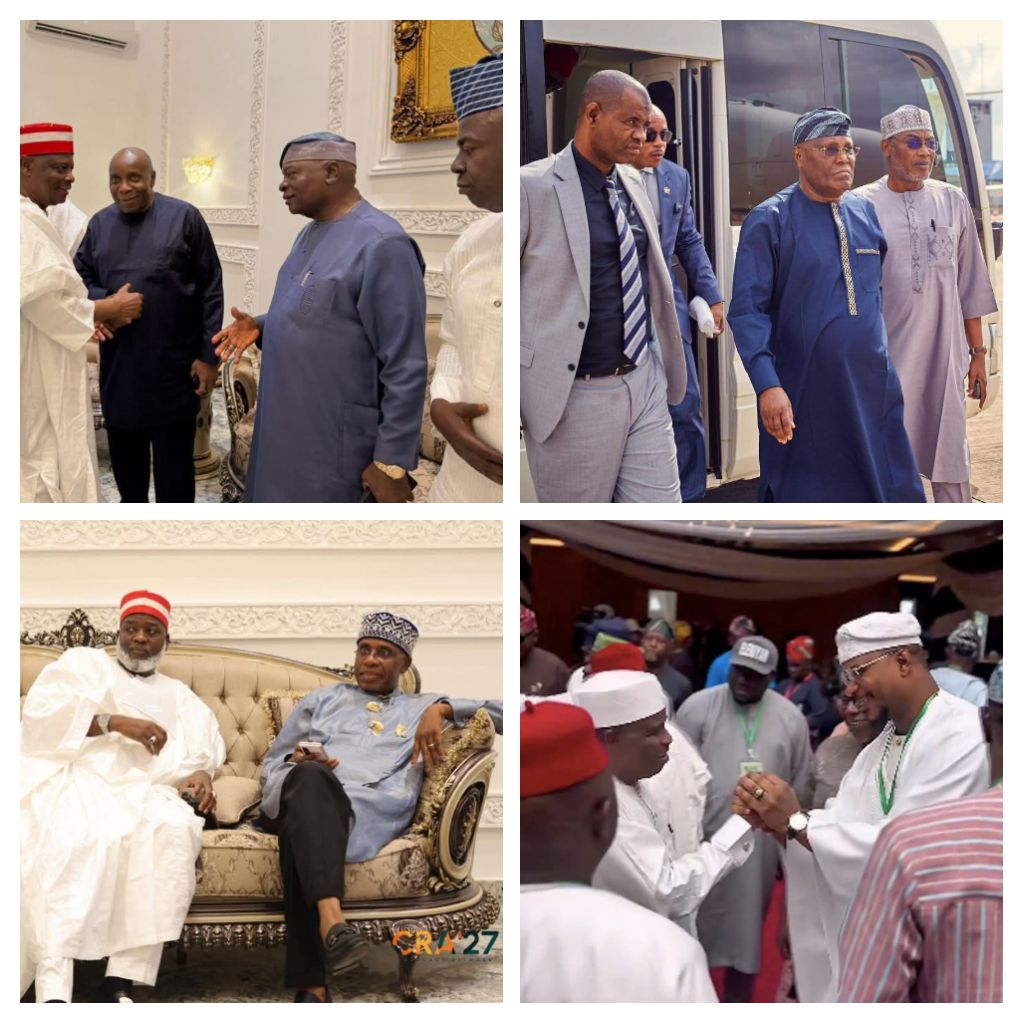
The political lions and leopards of Nigeria’s fractured opposition are attempting the improbable this weekend: lying down together.
Former President Olusegun Obasanjo — the old general who has spent his post-presidency playing kingmaker, critic, and conscience of the nation in equal measure — will chair a summit of rival opposition leaders at the Banquet Hall of Oyo State Government House. The host: Governor Seyi Makinde, whose own party loyalties have occasionally resembled a weather vane in a harmattan.
The gathering’s theme — “That We May Work Together for a United Opposition to Sustain Our Democracy” — carries the weight of a prayer and the scent of desperation.
By Saturday afternoon, the political heavyweights had begun touching down in the Pacesetter State like rival gang leaders answering a ceasefire summons.
Former Vice President Atiku Abubakar, the Peoples Democratic Party’s serial presidential candidate who has chased the Aso Rock dream so many times his ambition has its own frequent-flyer miles, announced his arrival with a terse post on X: “be have just arrived in Ibadan.”
Rabiu Kwankwaso, the Kano political strongman whose New Nigeria Peoples Party pulled millions of votes from the Northern belt, followed suit with performative enthusiasm: “Excited to arrive in Ibadan… ready for meaningful engagements.”
The African Democratic Congress confirmed the presence of former Transport Minister Rotimi Amaechi, seated alongside Nasiru Gawuna, the former deputy governor of Kano, and senior members of the Kwankwasiyya Movement — a tableau of political rivals who, under normal circumstances, would struggle to share a tea table.
The summit’s agenda reads less like a political strategy session and more like a national autopsy.
Former National Human Rights Commission chairman Chidi Odinkalu will address “the challenges of sustainable democracy.” Former House member Usman Bugaje will weigh in on good governance. Mike Igini, the former INEC resident electoral commissioner who became something of a prophet of electoral integrity, will present on free and fair elections — a subject that has become increasingly hypothetical in Nigerian political discourse.
Professor Pat Utomi, the political economist whose own presidential ambitions have outlasted several republics, will discuss building a productive national economy. Kabir Adamu, a security and intelligence expert, has drawn the grimmest assignment: examining “the tragedy of widespread insecurity in Nigeria.”
The official narrative, disseminated via the PDP’s X account, describes the meeting as “a strategic response to the socio-economic and security challenges currently facing the Federation.”
But the subtext is unmistakable: Nigeria’s opposition has recognized that divided, it cannot dislodge the All Progressives Congress. Whether united, it can, remains the unanswered question.
The ADC, in its own statement, called the summit a stage “for a strategic tightening of ties between key political blocs” — language that suggests something more binding than a mere handshake, though less concrete than a merger.
For now, the opposition has chosen Ibadan as the laboratory for its experiment in collective survival. The banquet hall will hold them. Whether it can hold them together is another matter entirely.