
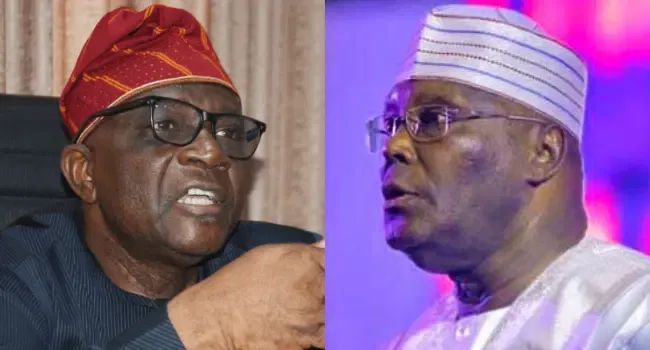
The Presidency has criticised former Vice President Atiku Abubakar’s proposal to restore petrol subsidy if elected president, describing the policy as a reversal of Nigeria’s ongoing petroleum-sector reforms and questioning how such a programme would be financed.
The Special Adviser to President Bola Ahmed Tinubu on Information and Strategy, Bayo Onanuga, in a statement on Thursday, August 20, said Atiku’s proposal amounted to a volte-face from his previous position on petrol subsidy and was driven by political desperation ahead of the 2027 presidential election.
The Presidency, however, acknowledged Atiku’s constitutional right to propose alternative policies, but said Nigerians were entitled to know the fiscal, legal and economic implications of returning to a subsidy regime that was dismantled under the Petroleum Industry Act (PIA).
The statement, titled “Restoring petrol subsidies: Atiku’s volte-face and desperation for power,” followed Atiku’s recent declaration that his administration would restore petrol subsidy if elected president.
Mr Onanuga said Atiku had previously advocated the removal of fuel subsidy in the run-up to the 2023 presidential election but had now reversed his position.
“Even though he used to believe that the subsidy regime must be eliminated, a point he canvassed in the run-up to his defeat in the 2023 election, he has now opportunistically recanted the major plank of his economic doctrine,” he said.
The Presidency argued that the proposal required closer scrutiny because Nigeria’s petroleum industry had undergone significant structural changes since the removal of petrol subsidy in 2023.
According to Onanuga, the subsidy was not simply money sitting in government coffers that could be deployed to make petrol cheaper, but represented the difference between the regulated pump price and the actual cost of supplying the product.
He explained that under the former arrangement, the Nigerian National Petroleum Company, NNPC, absorbed significant under-recoveries by selling petrol below its actual cost, leaving government with substantial financial obligations.
The Presidency also rejected Atiku’s claim that the removal of subsidy had generated a N30 trillion windfall or savings for the Federal Government.
“Contrary to Atiku’s claim in his interview, no N30 trillion subsidy windfall or savings exists anywhere except in his imagination,” Onanuga said.
He said the subsidy regime had already been dismantled under the PIA, which provided a new framework for the downstream petroleum sector and scheduled the end of petrol subsidy by June 2023.
According to him, President Tinubu merely accelerated the process by a few weeks after assuming office in May 2023 to prevent further financial losses.
The Presidency maintained that restoring subsidy would therefore require more than a presidential announcement, arguing that the government would have to establish a new legal, fiscal and administrative framework for the policy.
It said such a framework would have to clearly identify the source of funding and explain how subsidy payments would be administered under the current petroleum-market structure.
A major plank of the Presidency’s argument against subsidy restoration is the transformation of Nigeria’s petroleum landscape, particularly the emergence of large-scale domestic refining capacity.
Mr Onanuga said Nigeria had historically relied heavily on imported petrol, with government absorbing the difference between regulated pump prices and the cost of importing and distributing the product.
He argued that the emergence of the Dangote Refinery and other domestic refining facilities had fundamentally altered the dynamics of the downstream petroleum market.
According to him, returning to the old subsidy regime could undermine the investments and market conditions that have encouraged local refining.
He particularly warned that smaller domestic refineries could struggle if government once again introduced a heavily subsidised petrol market.