
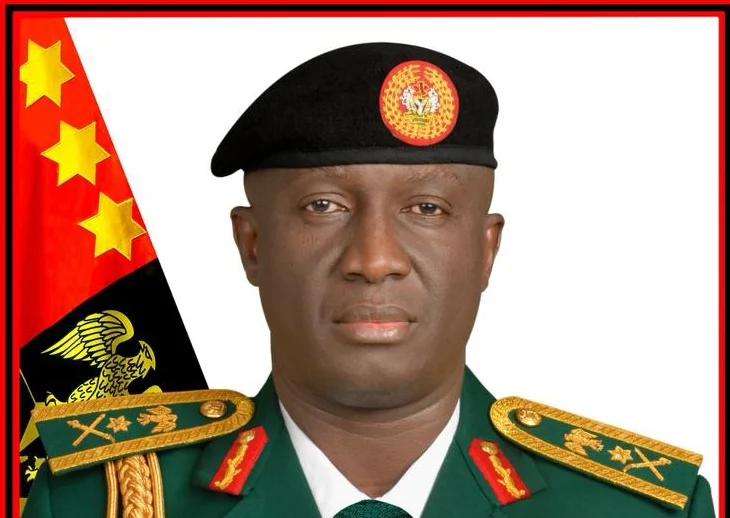
The chief of army staff, Waidi Shaibu, on Tuesday said the Nigerian Army has adopted a flexible, intelligence-driven and technology-enabled approach to confront Nigeria’s evolving asymmetric threats.
Mr Shaibu stated this on Tuesday in Abuja while delivering a lecture titled ‘Combating Asymmetric Threats to National Security in Nigeria: The Nigerian Army in Perspective’ to the participants of Course 34 at the National Defence College, Nigeria.
He said global security dynamics had shifted from conventional interstate wars to complex intrastate conflicts driven by non-state actors, terrorism, cybercrime, trafficking and transnational organised crime.
According to him, the army’s response combines kinetic operations, intelligence fusion, jointness with sister services and collaboration with domestic and international partners.
“Asymmetric threats exploit vulnerabilities and target civilians, institutions and critical infrastructure. Our response must therefore be adaptive, multi-domain and collaborative,” he said.
The army chief stated that Nigeria’s security environment mirrors global volatility, uncertainty, complexity and ambiguity, adding that the army had retooled doctrine and operations to match the threat. He said advanced capabilities, including unmanned aerial platforms, improved training and joint operations, had strengthened detection, interdiction and response.
Reviewing operations across geopolitical zones, Mr Shaibu said sustained campaigns in the North-East had degraded insurgent networks through population-centric counterinsurgency and regional cooperation.
According to him, theatre-wide operations in the North-West are dismantling bandit enclaves and restoring freedom of movement.
He added that the army’s posture in the North Central is focused on area domination, the protection of civilians, and the stabilisation of communal flashpoints through long-term joint task force frameworks.
Mr Shaibu stressed that national security had now transcended battlefield defence to include economic resilience, cyber protection, environmental safety and human security.
He urged the participants, described as Nigeria’s future strategic leaders, to embrace whole-of-government solutions that address the root causes of insecurity alongside military action.
“Sustaining gains requires governance, justice, development and community trust to complement military success,” he charged.
The army chief reaffirmed the army’s unwavering commitment to safeguarding Nigeria’s sovereignty, protecting citizens, and securing all critical national assets, as threats continue to evolve.
(NAN)