
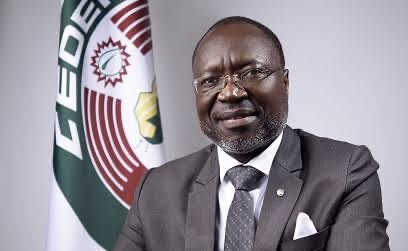
ECOWAS president Omar Touray says the bloc recorded 4.6 per cent economic growth in 2025 despite global economic challenges and envisages 5 per cent growth in 2026.
Mr Touray disclosed this on Thursday in Abuja during a meeting with development partners, while highlighting the commission’s 2025 Annual Report.
He said that ECOWAS outperformed the continental average in 2025 through structural reforms, rising investment in mining and energy, improved regional trade facilitation, and a strong rebound in services, transport and tourism.
“This robust performance is driven by structural reforms, rising investment in mining and energy, improvement in regional trade facilitation and a strong rebound in services, transport and tourism,” he said.
According to him, inflation, though still elevated in some member states, has declined in others due to coordinated monetary policies and improved food supply conditions.
“Our fiscal deficits have narrowed significantly as governments strengthen revenue mobilisation and rationalise public expenditure,” Mr Touray said. “Our debt-to-GDP ratio has also declined modestly, reflecting strong nominal growth and improved macroeconomic management.”
He noted that the sub-region’s external position remained sound, with a strengthened current account surplus supported by high export earnings from oil, gold, and bauxite.
“We are meeting at a time when the global economy is undergoing profound transformation. Geopolitical tensions, restructuring of supply chains and the rapid acceleration of digital and green transitions continue to reshape the global economic system,” he said.
Mr Touray further noted that global growth slowed in 2025 and uncertainty remained high, even as inflation eased slightly, but said Africa had continued to demonstrate resilience.
“Yet in the midst of these global headwinds, Africa continues to demonstrate remarkable resilience. Growth is recovering, inflation is declining, and political stability has improved in a number of countries,” Mr Touray explained.
He stated that peace and security remained at the core of the bloc’s mandate, adding that ECOWAS intensified preventive diplomacy, mediation and democratic support across the region in 2025. He said that ECOWAS would continue to manage the implications of the withdrawal of its three Sahel state members, Burkina Faso, Mali and Niger, while keeping channels open for constructive engagement.
Mr Touray disclosed that the ECOWAS Committee of Chiefs of Defence Staff completed the rotation of the Standby Force and reinforced preparations for both the Standby Force and the 1,650-strong Counterterrorism Brigade.
He said progress was made in combating organised crime and terrorism, with ECOWAS formally taking over the West Africa Police Information System after 12 years under Interpol. He, however, noted that reduced cooperation with the Alliance of Sahel States following its exit had complicated counterterrorism efforts.
“While attacks declined slightly, fatalities increased due to the rising use of improvised explosive devices,” Mr Touray said.
(NAN)