
By Abasi Ita
The Chairman, Senate Committee on Petroleum Resources (Upstream), Senator Eteng Williams, has called for tougher sanctions against offenders involved in hydrocarbon sector crimes.
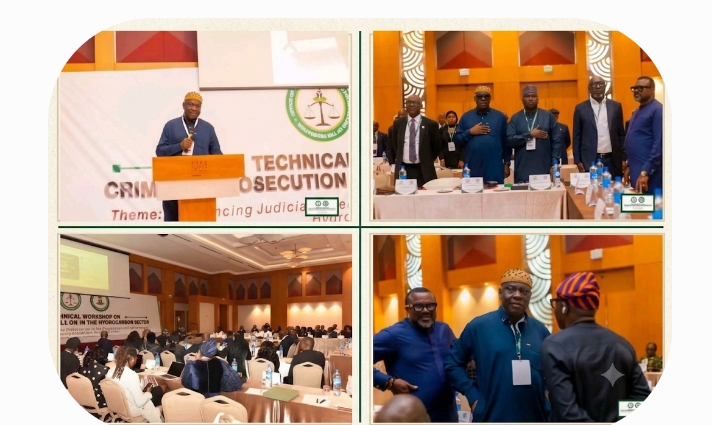
Williams made the call on Thursday while declaring open a three day technical workshop titled, “Enhancing Judicial Deterrence in the Prosecution and Sentencing of Hydrocarbon Sector Crimes,” in Ikot Ekpene, Akwa Ibom State.
The workshop was organised by the Directorate of Public Prosecutions of the Federation in collaboration with the Office of the National Security Adviser. It brought together judicial officers, prosecutors, security agencies, lawmakers and stakeholders in the oil and gas industry.
Williams warned that hydrocarbon related crimes posed serious threats to Nigeria’s revenue, energy security and economic stability.
He said petroleum related offences should no longer be treated merely as economic crimes, given their wider implications for national security, environmental protection, government revenue and energy supply.
According to him, oil theft, sabotage and other crimes in the sector could weaken the economy and undermine efforts to attract investment into Nigeria’s petroleum industry.
The senator stressed that effective prosecution must go beyond arrests, urging security and justice sector institutions to strengthen the entire criminal justice process, from detection and investigation to evidence gathering, prosecution, adjudication and sentencing.
“Our objective, therefore, should not simply be more arrests or prosecutions. We must strengthen the entire criminal justice chain, from detection and investigation to evidence gathering, prosecution, adjudication and sentencing, while protecting due process and the rights of accused persons,” he said.
Williams noted that the sophistication of petroleum related crimes required security and law enforcement agencies to improve their capacity to gather and analyse evidence.
He called for stronger forensic capabilities, financial intelligence, digital evidence management, technical expertise and interagency collaboration in investigating hydrocarbon crimes.
According to him, effective deterrence could only be achieved when offenders faced a justice system capable of successfully investigating cases, securing convictions where evidence supported them and imposing appropriate sentences.
The lawmaker disclosed that the National Assembly had commenced the process of amending the Miscellaneous Offences Act, 1983, and the Petroleum Production and Distribution (Anti Sabotage) Act, 1975.
He said the proposed amendments were aimed at strengthening Nigeria’s legal framework for tackling hydrocarbon sector crimes and related offences.
Williams, however, maintained that stronger laws must be complemented by effective enforcement and improved coordination among security agencies, prosecutors, the judiciary and relevant institutions in the petroleum industry.
The workshop attracted senators, members of the House of Representatives, a representative of the Chief Justice of Nigeria, senior judicial officers and representatives of the oil and gas industry.
The Nigeria Police Force, Nigeria Security and Civil Defence Corps and Nigerian Navy were among the security and law enforcement agencies represented.
The three day workshop is expected to examine gaps in the investigation, prosecution and sentencing of hydrocarbon related offences and develop measures to strengthen judicial deterrence against such crimes.