
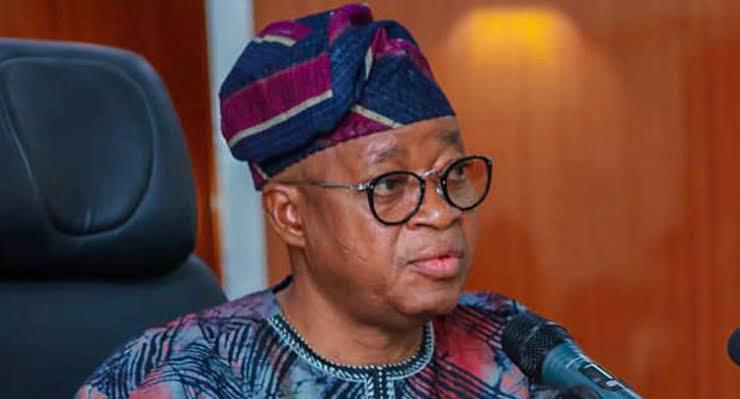
The federal government has approved the comprehensive modernisation and upgrade of Onne, Rivers, Delta and Calabar ports to improve efficiency, competitiveness and trade facilitation.
The Minister of Marine and Blue Economy, Adegboyega Oyetola, announced this in a statement by his special adviser on media and communications, Bolaji Akinola, on Sunday in Lagos.
Mr Oyetola said the approval complemented the earlier approval for the modernisation of Apapa and Tin Can Island ports in Lagos.
He said the initiative was part of the federal government’s broader strategy to reposition Nigeria’s maritime sector as a key driver of economic growth, trade, investment, industrialisation and employment.
According to him, the initiative aligns with President Bola Tinubu’s Renewed Hope Agenda, which prioritises infrastructure renewal and economic diversification.
Mr Oyetola said expanding port modernisation beyond Lagos would help reduce cargo concentration at the Lagos ports by providing efficient alternative gateways for international trade.
He said upgraded infrastructure and modern equipment at the four ports would increase cargo-handling capacity, reduce vessel turnaround time and lower the cost of doing business.
The minister added that improved port efficiency would strengthen regional connectivity and national supply chains while making the movement of goods more predictable and cost-effective.
He said the latest approval was part of the wider expansion of Nigeria’s maritime infrastructure, including plans for six new deep seaports across the country.
“The new deep seaports include Ibom Deep Seaport in Akwa Ibom, Bakassi Deep Seaport in Cross River, Agge Deep Seaport in Bayelsa, Gateway Deep Seaport in Ogun, Ondo Deep Seaport in Ondo and Bonny Deep Seaport in Rivers.
“Combining modernisation of existing ports with the development of new deep seaports will significantly expand Nigeria’s maritime capacity and create stronger economic corridors across the country,” Mr Oyetola said.
He said the government was working towards an integrated maritime and logistics system in which ports, roads, rail, and inland waterways would work together to facilitate cargo movement.
Mr Oyetola said the government’s objective was to build an efficient, transparent, and globally competitive port system that would reduce the cost and time of moving goods across international borders and to inland destinations.
He reaffirmed the ministry’s commitment to working with state governments, terminal operators, investors, shipping companies, and other stakeholders to translate the projects into sustainable economic growth and job creation.
(NAN)