
Stakeholders have “urged Nigeria to draw lessons from China’s remarkable poverty reduction experience and adapt relevant aspects of its development model to the country’s peculiar circumstances.”
The call was made on Tuesday in Abuja at a one-day workshop on “Nigeria’s Poverty Alleviation and China’s Development Modules,” organised by the Diplomatic Correspondents’ Association of Nigeria, DICAN.
The workshop, themed “Nigeria’s Poverty Alleviation Efforts: Adopting China Modules and Its Relevance in a New Era — The Place of Policy Makers, Development Partners and Diplomatic Reporters,” “examined how Nigeria could apply lessons from China’s development experience to its own poverty challenge.”
The Chinese Ambassador to Nigeria, Yu Dunhai, said “China had lifted more than 800 million people out of poverty since the launch of its reform and opening-up programme in 1978, accounting for more than 70 per cent of global poverty reduction.”
Dunhai, who was represented by Counsellor, Economic and Commercial Office of the Chinese Embassy, Sun Xuekun, said “the pace of the achievement was particularly significant, noting that nearly 100 million rural residents were still living below the poverty line at the end of 2012, but all had been lifted out of poverty by the end of 2020.”
“On average, more than 12 million people escaped poverty each year, equivalent to the population of a medium-sized country,” he said.
According to him, “China also removed 98.99 million rural poor residents, 832 impoverished counties and 128,000 impoverished villages from poverty.”
He attributed the achievement to “strong political commitment, targeted interventions, economic development, infrastructure investment and mechanisms designed to prevent people from falling back into poverty.”
Dunhai said “the Chinese government invested nearly 1.6 trillion yuan in special poverty alleviation funds and deployed more than three million officials and village work team members to establish a nationwide assistance network.”
He explained that “China moved away from generalised interventions to targeted poverty alleviation by identifying poor households, assessing the causes of poverty and matching interventions with specific local needs.”
The approach, he said, “included developing local industries, relocating communities from inhospitable areas, ecological compensation, educational assistance and stronger social security, alongside investments in roads, water, electricity, telecommunications, education and healthcare.”
Dunhai said “the Chinese experience demonstrated that poverty could be overcome through sustained development,” adding that “China had subsequently linked poverty reduction with rural revitalisation to consolidate the gains.”
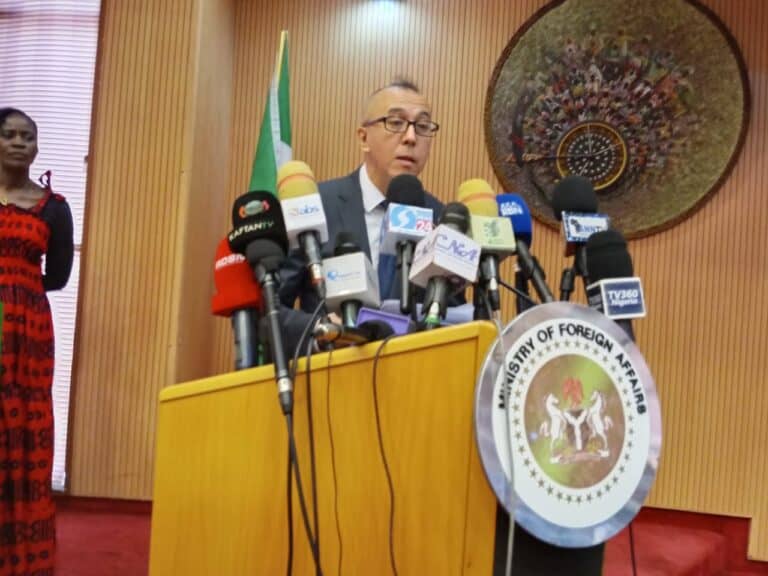
The Permanent Secretary, Ministry of Foreign Affairs, Ambassador Dunoma Umar Ahmed, said “Nigeria’s persistent poverty, unemployment and inequality required ‘bold, pragmatic and collaborative responses.’”
Ahmed, who was represented by the ministry’s spokesperson, Kimiebi Ebienfa, said “China offered valuable lessons in long-term planning, infrastructure-led growth, targeted poverty reduction and mobilisation of domestic resources, but warned against attempting to replicate the model wholesale.”
“Every country’s path must be shaped by its unique institutions, social fabric and values,” he said.
Ahmed said “Nigeria should instead identify elements of the Chinese experience that could be responsibly contextualised, particularly in agricultural productivity, social protection, public-private partnerships and human capital development.”
He said “policymakers, development partners and the media had complementary responsibilities in the process, with policymakers expected to develop coherent policies and institutional capacity, development partners to provide expertise and financing, and journalists to scrutinise implementation and keep the public informed.”
Also speaking, media scholar and public affairs analyst, Dr Austin Maho, said “Nigeria’s rapidly growing population made poverty reduction more than a social policy issue.”
Maho, who recently participated in a development conference in Yinchuan, China, said “Nigeria recorded an estimated 7.6 million births in 2025, compared with 7.9 million births in China, despite China having a population of about 1.4 billion.”
He warned that “unless Nigeria converted its growing population into a demographic dividend through jobs, education, infrastructure and productive opportunities, the trend could become a burden on the economy and public services.”
Maho said “Nigeria should study China’s experience critically rather than merely celebrate its achievements.”
“Models cannot be imported wholesale. They must be evaluated, communicated and contextualised,” he said, describing “diplomatic correspondents as a bridge between international development experience and domestic policy.”
He urged “the media to move beyond reporting official announcements and examine whether development projects were actually delivering benefits to citizens.”
Maho called for “the creation of development diplomacy beats in newsrooms, regular field reporting, collaboration with data institutions and the development of poverty indicators for monitoring governments.”
He also said “poverty reporting should focus on the lived experiences of Nigerians, rather than treating poverty merely as statistics in government and international reports.”
Similarly, Provost of the Anti-Corruption Academy of Nigeria and Head of Contemporary China-Africa Research, Prof Sheriff Ghali Ibrahim, identified “sustained economic growth, targeted poverty alleviation, infrastructure development, local industry promotion and bureaucratic accountability as central to China’s success.”
Ibrahim said “China used household-level profiling to identify the specific causes of deprivation and tailor interventions, while millions of officials and specialised teams were deployed to poor communities.”
He also highlighted “collaboration between wealthier and less-developed regions, relocation and resettlement programmes, and the expansion of road, electricity and digital infrastructure.”
Ibrahim cited “China’s ‘10,000 Enterprises Help 10,000 Villages’ initiative as an example of how the private sector could contribute to poverty reduction through industrial development, employment and public welfare.”
Earlier, DICAN Chairman, Idehai Frederick, said “the workshop was designed to examine China’s poverty reduction model while considering how it could be adapted to Nigeria’s socio-economic realities.”
Frederick said “China’s achievement of lifting more than 800 million people out of extreme poverty offered a compelling development experience, but stressed that adaptation, rather than direct replication, was necessary.”
He urged “stronger media exchanges, fellowships and technical journalism training between China and Nigerian diplomatic correspondents.”
The DICAN chairman also called for “greater efforts to exploit China’s zero-tariff policy for African exports by strengthening Nigerian supply chains, improving product standards and expanding non-oil exports to the Chinese market.”
He said “journalists were not merely observers of development policies but had a responsibility to document progress, expose shortcomings and help citizens understand the impact of government and international development initiatives.”
The workshop “underscored the need for Nigeria to combine lessons from international development experiences with stronger domestic institutions, reliable data, accountability and sustained investment in human capital and infrastructure.”