
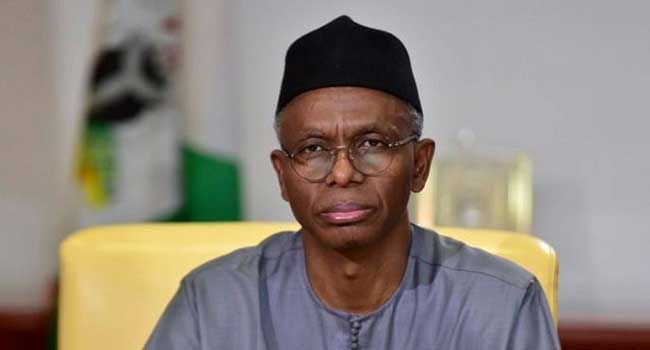
The Independent Corrupt Practices and Other Related Offences Commission (ICPC) has announced the recovery of equipment purportedly capable of intercepting conversations and accessing sensitive security documents from the Abuja residence of former Governor Nasir El-Rufai.
The commission has secured a legal order from a Magistrate Court in Bwari, Federal Capital Territory (FCT), allowing the detention of El-Rufai for a period of 14 days, which is set to expire on Thursday. In response to allegations of arbitrary detention and repression, the ICPC has refuted these claims.
Furthermore, the commission has requested that the High Court of Justice of the FCT dismiss El-Rufai’s application asserting violations of his fundamental human rights.
The ICPC has indicated that the former governor faces serious corruption allegations, including inquiries into the whereabouts of €1.4 million, 180 questionable payments totalling N2,158,799,199 from a Consolidated Revenue Account linked to Kaduna State’s Internally Generated Revenue (IGR) account, and transfers to undisclosed accounts amounting to N428,122,180.18, among other financial irregularities.
In addition, the commission confirmed that an aide associated with El-Rufai has allegedly fled the country, complicating the investigation.
These assertions were made in an affidavit submitted by Litigation Officer David Efuk to the High Court of Justice of the FCT, where El-Rufai is seeking relief and release from custody. The ICPC reported that all items were retrieved in the presence of the former governor’s wife, Hadiza, and their son, Mohammed.
The commission has also alleged that El-Rufai has declined to cooperate with investigators, choosing to remain silent until he is formally presented in court.
During the search operation, which took place at his residence on Mambila Street, Aso Drive, Asokoro District, Abuja, the ICPC retrieved sensitive security documents that could potentially compromise national security. The search was conducted under a duly signed warrant and witnessed by both Hadiza Isma El-Rufai and Hon. Mohammed Bello El-Rufai.
Notably, El-Rufai reportedly admitted on national television to intercepting telephone conversations belonging to the National Security Adviser, Mallam Nuhu Ribadu. Despite being requested to provide consent for access to the retrieved equipment, he reportedly refused.
The ICPC further stated that the former governor has allegedly threatened potential prosecution witnesses, one of whom has formally requested protection from the commission.
The ICPC maintains that El-Rufai’s detention is lawful, having been sanctioned by the Magistrate Court in Bwari, which granted the commission 14 days to carry out necessary investigations.
In its response to El-Rufai’s claims, the commission stated: “Contrary to the statements made in the applicant’s supporting affidavit, he is lawfully held in custody, and the commission has not infringed upon any of his fundamental rights as alleged.
“ICPC does not engage in arbitrary arrests or unlawful detentions, nor does it pose any threat to suspects. Our mandate is to investigate cases of corruption, abuse of office, and related offences, and to prosecute alleged offenders when there is prima facie evidence.”
The ICPC has committed to preparing charges against El-Rufai before the detention order expires on 5 March 2026.
The commission asserts that it followed the appropriate legal procedures in inviting El-Rufai for questioning based on a petition alleging corrupt practices. The petition raised serious concerns regarding discrepancies in the state’s debt profile, cash withdrawals in foreign currency amounting to €1.4 million, alleged diversions of public revenue, and other financial irregularities.
The allegations further detail that the past administration accrued approximately N98.912 billion in domestic loans for development projects in Kaduna State, alongside over $7.366 billion in foreign loans, purportedly to be serviced by the people of Kaduna State.
El-Rufai has responded to the ICPC’s actions, asserting that he is being targeted due to his position as a prominent member of the African Democratic Congress (ADC), which he claims is the only viable opposition party in Nigeria.
He stated, “I have decided to exercise my right to silence until I am arraigned before a court. I believe that after nearly two years of intensive investigation, the ICPC should present its findings before a judicial tribunal and not to me. I will respond to any allegations only in a court of law. I do not believe these investigations constitute law enforcement; rather, they represent political persecution that can only be adjudicated by a judge.”
As the investigation continues, the implications for El-Rufai and the broader political landscape in Nigeria remain significant. The ICPC’s commitment to transparency and accountability will be crucial in navigating this high-profile case.