
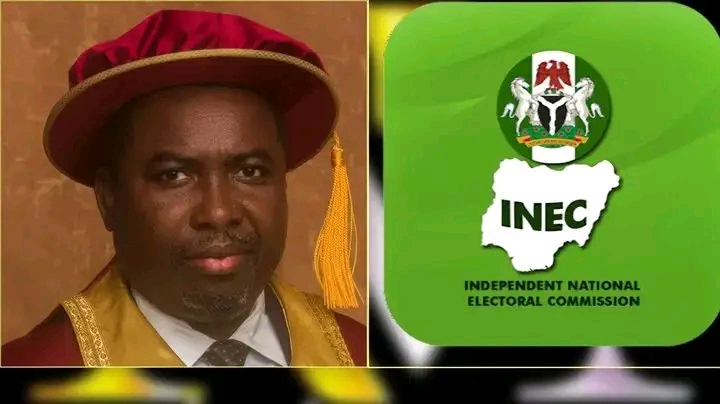
The Independent National Electoral Commission (INEC) said it will conduct a thorough clean-up of the country’s voter register to further sanitise and strengthen the register’s integrity.
The INEC Chairman, Prof. Joash Amupitan, said this during the commission’s quarterly consultative meeting with Civil Society Organisations on Wednesday in Abuja.
Mr Amupitan said that a credible register of voters remained the bedrock of free, fair and transparent elections, stressing “no electoral process can command public confidence without trust in the integrity of its voters’ register.”
He noted that Nigeria’s national register, first compiled ahead of the 2011 general election, had since been continuously updated and deployed in the general elections of 2011, 2015, 2019 and 2023, as well as in several off-cycle governorship and by-elections.
Mr Amupitan, who noted that the country’s voter register as of 2023 general elections stood at 93,469,008, said that the persistent challenges however remained.
According to him, the challenges include duplicate registrations, underage registration, registration by non-citizens, deceased voters and incomplete or inaccurate records.
He added that such anomalies undermine public confidence in the electoral process.
He said, “Accordingly, the commission will be embarking on a nationwide Voter Revalidation Exercise ahead of the 2027 general election. This is very important for us, because most of the time we talk of voter apathy.
“When we conducted Anambra State governorship elections there were over 2.8 million registered voters. As much as we tried to mobilise, the total number of voters was less than 600,000, and that was about 20 per cent of the registered voters.
“So the general outcry is, oh, voters did not turn up. But sometimes, when we’re looking at the register of voters, for example in Anambra State, we discovered names of prominent politicians in Nigeria that have died; their names are still on the register. This, in a way, is an indictment on the register itself.
“So we’re going to clean up and ensure that we don’t continue to expect dead people to come from their graves and vote on the day of election. We don’t also expect their posts to come from such elections.”
Providing an update on the associations seeking registration as political parties, Mr Amupitan said that the commission would soon release the details of successful associations ahead of 2027 general election.
The INEC chairman recalled that INEC received a total of 171 letters of intent from associations seeking registration as political parties.
He said that the associations were assessed in line with Section 222 of the Constitution of the Federal Republic of Nigeria, 1999 (as amended), Section 79(1), (2) and (4) of the Electoral Act, 2022, as well as Clause 2 of the Commission’s Regulations and Guidelines for Political Parties, 2022.
He added that several of the associations were unable to fulfill the constitutional requirements and the requirements of the Electoral Act, 2022, as well as the regulations and guidelines for political parties.
“Let me assure you that the successful association(s) will soon be announced by the commission,” Mr Amupitan said.
Speaking on the ongoing Continuous Voter Registration (CVR), Mr Amupitan said that the second phase of the exercise commenced on January 5 and would run until April 17.
He said that the entire CVR was scheduled to span one year to end on August 30.
The INEC chairman noted, “In the first phase of the ongoing Continuous Voter Registration exercise conducted from August 18 to December 10, 2025, the commission registered a total of 2,782,589 eligible voters.
“We are encouraged by the strong public response to the exercise, which affirms the belief of Nigerians in the democratic process and in the efforts of the commission to ensure that every eligible citizen is afforded the opportunity to register and vote.
“For transparency purposes, data on completed online pre-registrations and physical registrations are published weekly on the commission’s website.”
The meeting was attended by representatives of registered CSOs.(NAN)