
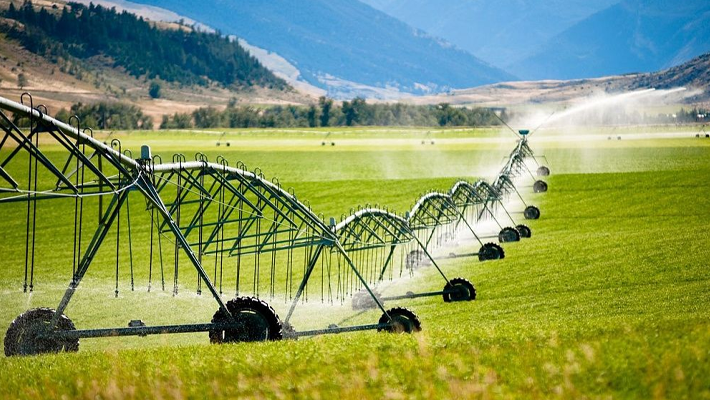
Iran is rolling out 110 pilot smart irrigation projects spanning around 10,000 hectares as part of a nationwide drive to enhance water productivity.
Safdar Niazi Shahraki, deputy minister for water and soil affairs at the country’s agriculture ministry, said the country is also expanding the use of renewable energy in the agricultural sector.
Mr Shahraki said the initiatives were now in their third year and extended across almost all provinces.
According to the deputy minister, the schemes will be scaled up nationwide once the pilot phase is completed.
Alongside this effort, authorities intend to equip approximately 230,000 electric agricultural wells and 200,000 diesel-powered wells with solar panels, as reported by Tehran Times, a TV BRICS partner.
The minister also said that the ministry was broadening the adoption of advanced technologies in farm management.
He said the programmes include the application of artificial intelligence to irrigation, Internet of Things solutions in fields, satellite-based crop monitoring, and the creation of national databases for water and soil resources and digital soil maps.
He added that the work was progressing in parallel on modern water transfer networks and decision-support platforms for producers.
On the energy side, the minister said the government had allocated about $400 million to support the installation of solar panels in agriculture, with a specialised engineering body appointed to supervise delivery.
He emphasised that achieving the plan’s wider agricultural objectives, among them the annual deployment of modern irrigation systems across 200,000 hectares, along with drainage, canal rehabilitation, and soil studies, would require funding of roughly $3.5 billion per year.
As climate pressures intensify and water resources come under greater strain, raising farm water-use efficiency is becoming ever more important, particularly as part of agricultural supplies is redirected to meet drinking-water needs.
(TV BRICS/NAN)