
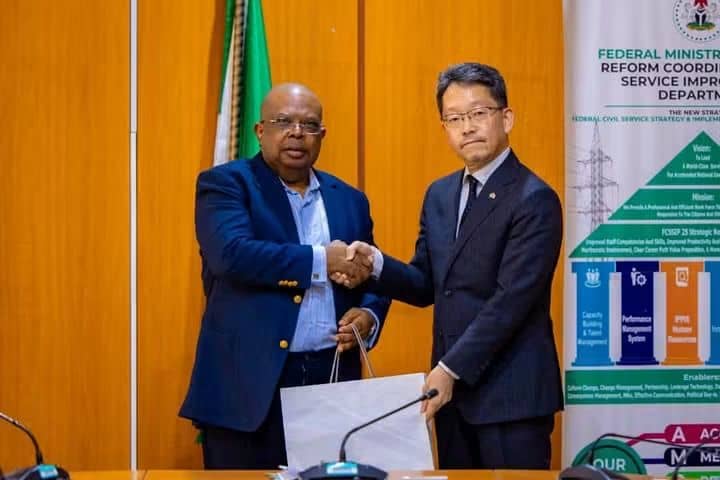
The Government of Japan, through the Japan International Cooperation Agency, JICA, has committed N20 billion to the expansion and rehabilitation of Nigeria’s national electricity grid.
Ishigame Keiji, Chief Representative of JICA, disclosed this in an interview with the News Agency of Nigeria on Wednesday in Lagos.
Mr Keiji said the “2.35 billion Japanese Yen commitment would support the expansion of the Apapa Transmission Substation in Lagos.”
He said the project was aimed at “rehabilitating and reinforcing critical transmission infrastructure in Lagos, where rising electricity demand and ageing facilities had continued to affect reliable power supply.”
“This includes construction works, equipment procurement, engineering services, operational training and project implementation support necessary to achieve the project’s objectives,” Keiji said.
“Apapa Substation occupies a vital position within Nigeria’s transmission network. The rehabilitation and reinforcement undertaken through this project have enhanced transmission capacity. It has improved operational reliability, strengthened grid stability and reduced bottlenecks affecting power evacuation and distribution within Lagos and surrounding areas,” he added.
According to him, Japan, through JICA, “is also implementing another Official Development Assistance (ODA) project through a concessional loan to enhance the transmission network in the Lagos-Ogun areas.”
He said Japan would provide “technical assistance and policy advisers to the Ministry of Power as part of its support for the development of Nigeria’s power sector.”
“The Government of Japan, through JICA, is collaborating with the Ministry of Power to enhance stable and reliable power supply in Nigeria,” Keiji said.
Speaking on private sector involvement, the JICA chief said “Nigeria has a big, huge market, and the private sector, including Japanese companies, is quite interested in investing in the country.”
“What we are doing in Nigeria is assisting the country to improve its power sector. We are providing technical cooperation, including policy advice and implementation regulations. So, our government support and private sector involvement will contribute to improving the power sector in Nigeria,” he said.
Keiji urged the Federal Government and private investors to pursue “a balanced mix of on-grid, off-grid and mini-grid solutions to improve electricity supply across the country.”
He said JICA “is collaborating with the World Bank to support the development of mini-grids, particularly in rural communities.”
“So, this best mix needs to be considered in Nigeria. I think Nigeria needs to pursue the best mix of mini-grids, off-grid and on-grid solutions,” he said.
The JICA chief representative added that the agency “is also collaborating with the Ministry of Power by deploying experts to support policy recommendations and institutional improvements.”
He said the support was expected to contribute to “the development of a more reliable and sustainable power sector in Nigeria.”