
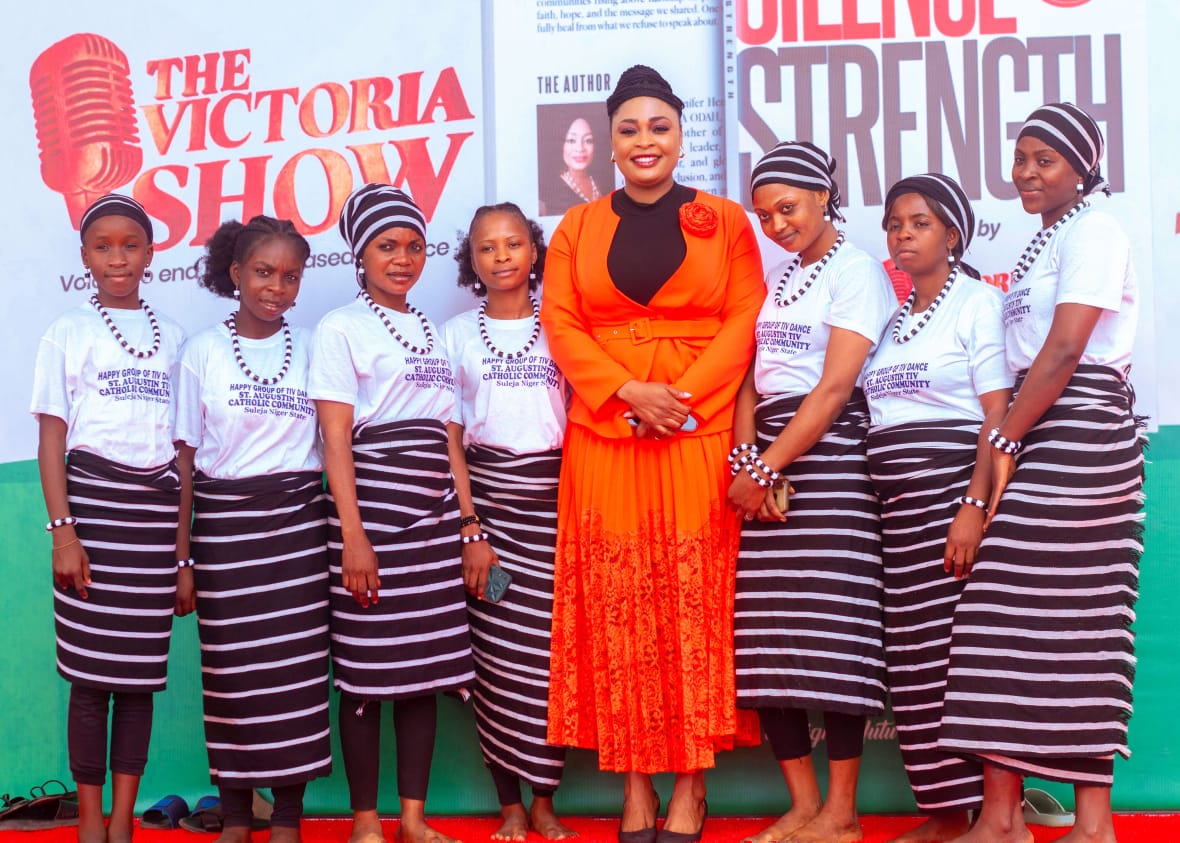
On a warm afternoon in a rural Benue community, a young girl clutched a school bag that had arrived later than expected—but not too late. For months she had been absent from class, not because she lacked interest, but because poverty had quietly decided for her. That day, as women gathered beneath a mango tree for training and support, her return to school was quietly secured. There were no speeches or cameras. Just a promise restored.
Scenes like this define the work of Chief Jennifer Hembafan Alih, widely known as The OJAMALIA ODAH—a young humanitarian leader whose influence stretches across rural Benue, Kogi State and the overlooked settlements surrounding Nigeria’s Federal Capital Territory. Her interventions have directly touched tens of thousands and indirectly reached more than 800,000 people, but their true measure lies in these small, life-altering moments.
Alih’s leadership is best understood through proximity rather than proclamation. She shows up where systems thin out—where women shoulder households on fragile incomes, where girls navigate adolescence without guidance, and where silence has long been mistaken for resilience. Her interventions are deliberately modest and deeply human: education support, livelihood empowerment, health awareness, disability inclusion and community resilience. Each is designed not as relief, but as reinforcement.
In Benue State, her work has focused on women whose lives revolve around subsistence and uncertainty. Through skills training, agricultural support and education advocacy, women and women farmers who once resigned to survival now earn small incomes and plan beyond the next harvest. Girls who had drifted from school return, their futures widened by a few decisive interventions. Progress here is incremental, not dramatic—but it endures.
Kogi State presents a different challenge: remoteness. In villages where public attention rarely lingers, Alih’s approach has been intensely personal. She funds initiatives with her own resources, supports families quietly, and returns often enough to build trust. Beneficiaries speak less about programmes than about recognition. “She treated us as capable people,” one woman remarked. “Not as charity cases.”
In the peri-urban communities of the Federal Capital Territory, her work takes on another dimension. Here, women and girls live close to power yet far from its benefits. Through JUWACI—the Julebrama Women and Children Initiative, which she founded and leads—Alih delivers public-health awareness, first-aid training and empowerment sessions that equip women with both knowledge and confidence. For young girls navigating risk with little protection, these interventions send a clear message: your life is worth investing in.
These same interventions are replicated in the other states of Kano, Borno, kaduna Nasarawa, Adamawa, Ebonyi, Lagos and Ondo states.
What binds these efforts is method. Alih blends strategy with compassion, service with vision. An agricultural expert by training, a civil servant with the National Open University of Nigeria and a social entrepreneur, she approaches development with the discipline of a planner rather than the sentiment of a benefactor. Her work spans education, disability inclusion, climate action, public health, entrepreneurship and civic engagement—each treated as part of an interconnected system.
This structured empathy places her in a lineage of women whose leadership reshaped social care from the margins. Mother Teresa demonstrated that compassion could be systematic; Edna Adan Ismail of Somalia showed that reform required institutions and persistence. Alih’s work reflects a contemporary African iteration of that philosophy: locally grounded, globally informed and stubbornly practical.
Her youth adds to the story’s significance. In societies that often equate leadership with age, she represents a generation more concerned with outcomes than office. She does not wait for donor cycles or official endorsement before acting. Instead, she seeds projects personally and scales them through partnerships and community ownership. It is leadership that absorbs risk rather than deferring responsibility.
Recognition has followed. A fellow of the Mandela Washington Fellowship and recipient of its Most Courageous Fellow distinction, Alih has earned national and international honours, including a revered chieftaincy title. Yet accolades remain peripheral to her work. In the communities she serves, what matters more is consistency: the return visits, the follow-through, the refusal to forget.
The impact reveals itself in quiet transformations: a woman who starts a cooperative, a girl who resumes schooling, a mother who learns first aid and saves a child. These stories rarely travel far, but they accumulate into something consequential—a shift in expectations, a redefinition of what is possible.
Alih does not romanticise hardship, nor does she exaggerate her reach. She is clear-eyed about limits. But she is equally firm in her belief that silence deepens wounds. Her philosophy is simple: no background should imprison destiny, and humanity rises highest when it lifts its weakest.
As development debates grow louder and more abstract, her work offers a quieter lesson. Progress is local. It happens when someone shows up repeatedly, listens carefully and acts responsibly. It happens when compassion is organised.
In the rural corners of Benue, the remote villages of Kogi and the margins of the nation’s capital, Chief Jennifer Hembafan Alih’s work has already made its case. Strength, it turns out, does not always announce itself. Sometimes, it grows patiently—where silence once prevailed.
Abdullahi O Haruna Haruspice is a fellow of the Mandela Washington program and writes from Abuja.