
By Achile Danjuma
Nigeria’s long-dormant industrial dream took a major step towards reality on Thursday as the Kogi State Government officially received the licence to operate the Ajaokuta Economic City Free Trade Zone, a 4,000-hectare project poised to unlock the country’s vast steel and solid minerals potential.
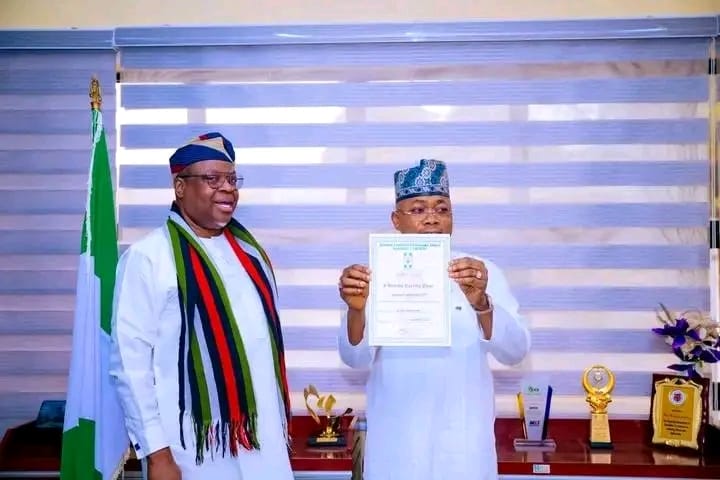
Governor Usman Ododo received the certificate from the Nigeria Export Processing Zones Authority (NEPZA) in Abuja, marking the formal green light for a project first authorised by President Bola Tinubu in November 2025.
Describing the moment as a “historic turning point,” Ododo said the state is now ready to aggressively court both local and foreign investors, positioning Ajaokuta as a major industrial hub for West Africa.
“This certificate is a special product,” Ododo said after receiving the document. “Sometime last year, I was here to present reasons why Kogi State should be considered for this project. The authorities guided us through due diligence, and when you have a leader who sincerely places the interest of the people first, the result is what we are seeing today.”
The governor framed the free zone as a long-overdue catalyst for economic transformation, leveraging Kogi’s unique geographical advantages. He noted that the state borders 10 commercial nerve centres, including the Federal Capital Territory, and is endowed with over 30 solid minerals in commercial quantities—including coal, iron ore, lithium, gold, and beryllium.
“These resources have never worked for us,” he admitted. “But this free trade zone will change that. It will take the lead among all zones in the country.”
Addressing widespread scepticism over the long-moribund Ajaokuta Steel Company, the governor insisted that the Federal Government is making quiet but significant progress. He disclosed that investors are currently assessing the plant, with an ambitious target to have it operational before the end of the year.
“Some people are not aware of what Mr President is currently doing in Ajaokuta,” Ododo said. “With the coming of this free trade zone, the project will advertise itself and add to the economic sustainability of our nation.”
To support the anticipated industrial boom, the governor revealed plans to construct an international airport in the state. The facility is designed to serve as a complementary hub to Abuja’s Nnamdi Azikiwe International Airport, capitalising on Kogi’s proximity to the capital.
“This airport will not be just for local operations. It will be international,” he stated. “We want to take advantage of our closeness to Abuja so that the overflow will be accommodated in Kogi State.”
In a final challenge to the media and the public, Ododo invited journalists to visit the state and assess his administration’s developmental strides first-hand, distancing his government from what he termed “noisemakers on social media.”
“This certificate is an asset, and it will be part of the legacy for future generations,” he added.
In his remarks, NEPZA Managing Director Dr Olufemi Ogunyemi described the licence issuance as the beginning of a long but promising journey, pledging the agency’s full support to develop the zone into a world-class economic destination.