
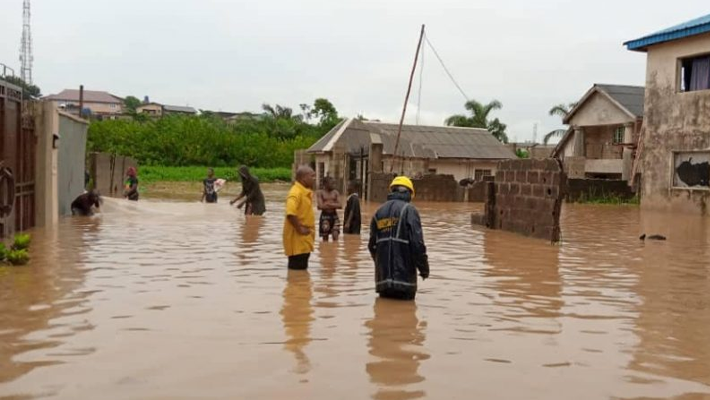
The National Emergency Management Agency says its proactive mitigation strategies have led to a significant reduction in flood-related fatalities.
The agency said 241 lives were lost in 2025, compared to over 1,000 deaths recorded in 2024.
The NEMA assistant director of planning, Dapo Akingboade, disclosed this in Abuja during an after-action review of the 2025 climate-related disasters in Nigeria.
Presenting a comparative analysis, Mr Akingboade disclosed that over five million people were affected by flooding in 2024, adding that the number dropped to less than 500,000 in 2025.
Similarly, the number of displaced persons fell from over one million to approximately 58,000 within the same period.
According to him, 27 states were affected in 2025 across 128 local government areas, a marked improvement from the 35 states impacted the previous year.
Mr Akingboade attributed these results to the early dissemination of forecasts by the Nigerian Meteorological Agency and the translation of early warning messages into three major Nigerian languages to reach grassroots communities.
He, however, identified lingering challenges such as poor drainage maintenance, residents in high-risk areas’ refusal to evacuate, and limited accessibility to certain communities during peak flooding.
NEMA urged state governments to operationalise their local contingency plans and prioritise urban drainage management to further reduce risks in the 2026 season.
Speaking on the weather outlook for 2026, NiMet’s assistant chief meteorologist Abubakar Sadiq revealed that the agency achieved 74 per cent accuracy in its rainfall predictions for the previous year.
Mr Sadiq stated that NiMet was transitioning toward more objective, automated forecasting scripts to improve reliability despite the challenges posed by rapid climate change.
Speaking on the recent unusual weather patterns in the Federal Capital Territory, Mr Sadiq clarified that the massive systems observed were “extra-tropical features” caused by a mid-latitude trough passing through West Africa.
According to him, such systems pull moisture deep into the hinterland, reaching as far as Kano and Maiduguri.
On the collaboration between NiMet and the Nigeria Hydrological Services Agency, Mr Sadiq said both agencies utilised the Standardised Precipitation Index, a global tool used to monitor drought and flood risks.
Mr Sadiq also noted that the agency’s vigilance extended to health-related climate impacts, providing predictions for malaria and meningitis prevalence based on temperature and humidity variations for the early months of 2026.
According to him, NiMet and NIHSA are working closely using the SPI to harmonise flood and drought monitoring.
Earlier, Godwin Tepikor, NEMA director of planning, research and forecasting, stated that the inclusion of the 2025 After Action Review was deliberate and aimed at drawing lessons from previous emergency responses to strengthen future interventions.
He explained that the technical meeting aimed to analyse 2026 climate predictions and craft strategies to mitigate flood risks in Nigeria.
The meeting brought together key stakeholders from the government, security agencies, and humanitarian and development sectors to boost Nigeria’s flood preparedness.
(NAN)