
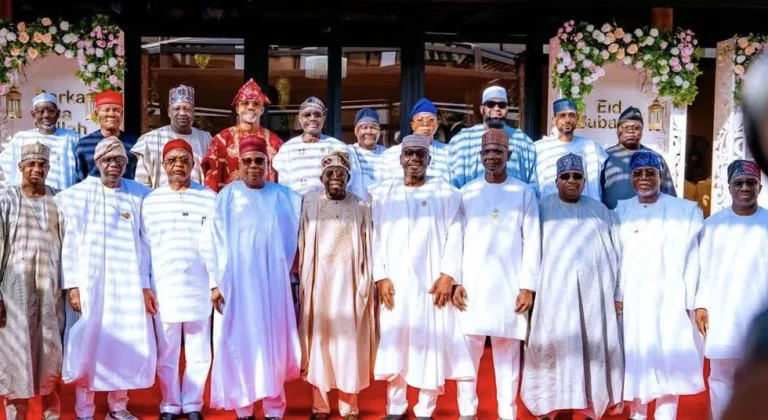
President Bola Tinubu has described the early period of his administration as a difficult and politically demanding phase, saying he faced intense pressure while pushing through tough economic reforms.
He said the journey required resilience, noting that several allies within the ruling party stood firm despite uncertainty about the direction of his policies.
“It was very, very challenging. It was tough for those who were in the party with me. Some kept faith, and instead of dodging the bullets, I took it. I took it on the chin. Very hard work,” he said.
Tinubu explained that many governors and party stakeholders supported him based largely on trust in the party platform, even without prior knowledge of the specific policy decisions that would follow.
“I didn’t disclose to anybody what I would do. Many of you took the risk and went along because of the party platform and everything. We survived. You faced litigations and accusations, and we survived it,” he added.
The President maintained that despite initial fears of economic instability, Nigeria had avoided collapse and was now on a recovery path.
“Instead of bankruptcy, Nigeria has survived. The economy has recovered. It is growing. Agriculture is humming. Food is here,” he said.
He praised state governors for helping to sustain public confidence during the implementation of his administration’s reforms, saying their cooperation was critical in managing the transition period.
Tinubu noted that the country is now beginning to see the results of the policy adjustments, particularly in infrastructure and economic indicators.
“You kept the spirit, you kept the hope, you persuaded our people to be patient, to endure these three years of painful reforms, while we put the economy on reset,” he said.
“Today, the benefit is showing. The economy has recovered, macroeconomic indices are doing very well. Construction is ongoing on roads and infrastructure. The ones abandoned are being rehabilitated. The housing industry is coming on very well.”
He also said the financial position of many states had improved, reducing reliance on borrowing and federal bailouts.
“I am glad that out of the 27 governors borrowing from the federal government and asking for interventions, we are no longer struggling to pay salaries. No more,” he said.
Highlighting long-term development plans, Tinubu referenced major infrastructure projects such as the Sokoto–Badagry corridor, describing them as key to unlocking agricultural and economic potential.
“Imagine how many dams on that corridor for irrigation, for farming land, for electricity,” he said.
He urged governors to take advantage of available land resources to boost agriculture, insisting that Nigeria has the capacity to achieve food sufficiency and long-term food security through proper planning and execution.