
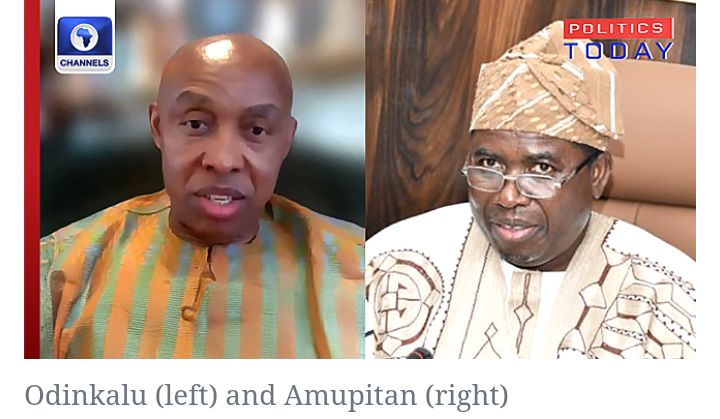
The Independent National Electoral Commission (INEC) is facing fresh allegations of executive interference, following claims that its Chairman, Prof. Joash Amupitan, was compelled to issue a recent statement under threat of forced resignation.
The controversy stems from a Wednesday press release in which INEC announced its intention to remove the names of Senator David Mark and former Osun State Governor, Rauf Aregbesola, from its official portal as leaders of the African Democratic Congress (ADC). Senator Mark serves as the party’s National Chairman, while Aregbesola is its National Secretary.
Citing a subsisting leadership dispute, INEC stated it would suspend recognition of any faction of the ADC pending the final determination of a case at the Federal High Court, Abuja.
The announcement was formally issued by Mohammed Kudu Haruna, INEC’s National Commissioner and Chairman of the Information and Voter Education Committee. The Commission attributed its decision to “preservatory orders” from the Court of Appeal in Appeal No. CA/ABJ/145/2026, involving Senator David Mark and Nafiu Bala Gombe.
However, in a late-night post on X (formerly Twitter) on Wednesday, legal scholar and former Chairman of the National Human Rights Commission, Prof. Chidi Odinkalu, alleged that the Commission’s statement followed intense behind-the-scenes pressure over the preceding 60 hours.
According to Odinkalu, these meetings involved senior INEC officials, the Presidency, and representatives of both the Court of Appeal and the Federal High Court.
The most serious allegation leveled by Odinkalu concerns the circumstances of Prof. Amupitan’s appointment. Citing what he described as “impeccable authority,” Odinkalu claimed that Amupitan was required to submit a pre-signed, undated resignation letter as a precondition for assuming the role of INEC Chairman.
He asserted that the threat to release this letter was used to force the Chairman’s compliance with the recent interpretation of the court ruling.
“I have it on the most impeccable authority that there is a pre-signed resignation letter by Chairman Amupitan. It was a pre-condition for his appointment,” Odinkalu wrote. “The threat of releasing it did the magic.”
Odinkalu further questioned the legal rationale behind INEC’s statement, arguing that it is not the function of the electoral body to interpret judgments of the Court of Appeal. He noted that a commission acting in good faith, faced with any ambiguity in a ruling, would seek formal clarification from the appellate court directly.
“It should be evident to a professor of law and SAN that it is not the business of INEC to interpret the decision of the Court of Appeal,” he stated.
The allegations surface as Nigeria prepares for the 2027 general election cycle. Odinkalu warned that the incident reflects a broader pattern of institutional subversion, adding that the country “stares down a barrel.” He suggested that the current political climate has reached a critical juncture, where only those willing to either enable or challenge the existing system fully grasp the stakes of the upcoming elections.
INEC has yet to issue an official response to the allegations of duress or the existence of a pre-signed resignation letter.