
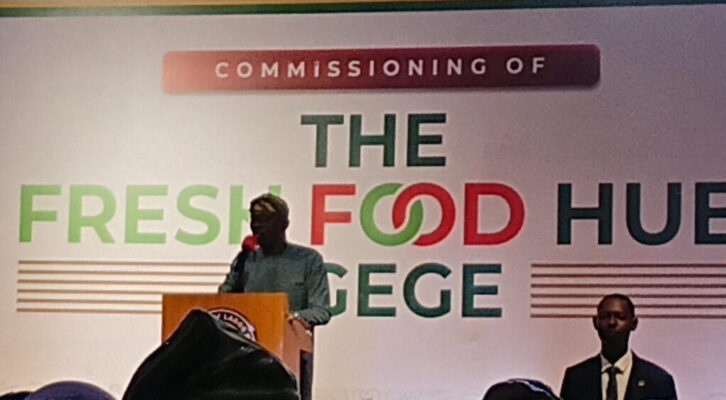
Lagos State Governor Babajide Sanwo-Olu on Wednesday inaugurated the Agege Fresh Food Hub as part of efforts to strengthen food security and improve the distribution of agricultural produce across the state.
Speaking at the commissioning, Sanwo-Olu said Lagos’ food economy was worth more than N1.6 trillion, while noting that over 75 per cent of the food consumed in the state was sourced from outside its borders.
He said the dependence on external food supplies made it necessary for the government to improve the entire food chain, including aggregation, transportation, storage, processing, financing, regulation and distribution.
According to the governor, food security goes beyond increasing production, as the state must also build an efficient system capable of moving food from farms to consumers quickly and safely.
Sanwo-Olu said his administration was therefore creating an integrated food system that would bring farmers, aggregators, processors, logistics providers, traders and consumers into a more coordinated network.
He explained that the Agege hub was part of a broader plan to establish modern food distribution centres across Lagos. The government had earlier commissioned the Fresh Food Hub in Abijo, with similar facilities planned for other parts of the state.
The governor said the Agege facility would provide modern trading, storage and logistics services, helping to minimise food wastage, improve farmers’ access to markets and create more opportunities for businesses involved in the agricultural value chain.
He added that the long-term plan was to establish structured food hubs across virtually every part of Lagos so that communities could have better access to modern food infrastructure.
Sanwo-Olu also highlighted the government’s investment in human-capital development, including the training of farmers and agricultural entrepreneurs. He said more than 4,000 young people had benefited from the Lagos Agripreneurship Programme, while agricultural initiatives had also been introduced in schools to expose students to opportunities in the sector.
The governor stressed that achieving food security required collaboration between government and the private sector, including farmers, financial institutions, logistics companies, traders, technology firms and development partners.
He said the effectiveness of the food system would ultimately be judged by whether farmers earned better incomes, traders grew their businesses, consumers could access nutritious food at affordable prices and investors maintained confidence in Lagos.
Sanwo-Olu described the Agege hub as a shift from simply building infrastructure to operating a coordinated food system, saying the state was moving from individual projects to an integrated approach.
Earlier, the Chairman of Agege Local Government, Ganiyu Obasa, described the project as an important development for the area’s economy.
Obasa said the facility was more than a new physical structure, noting that it would strengthen Agege’s role in connecting farmers, traders, distributors and consumers.
He also pointed to Agege’s strategic position as a major commercial corridor, saying the new hub would complement the area’s long-standing culture of entrepreneurship and commercial activity.
The Commissioner for Agriculture and Food Systems, Abisola Olusanya, said the facility would serve as a major component of Lagos’ emerging food distribution network.
She explained that the hub would support food aggregation, storage, logistics, wholesale and retail activities while helping to reduce food losses, congestion linked to food trading and inadequate storage facilities.
Olusanya said the project was backed by a 351-page operating framework covering areas such as operator selection, produce reception and quality control, storage, sanitation, waste management and the use of training facilities.
She said the facility covers about 7,000 square metres, with a 4,000-square-metre trading floor, cold-storage facilities, rice storage, seafood facilities, parking spaces and electric-vehicle charging points.
According to her, the hub is expected to facilitate food transactions worth more than N5 billion once fully operational.
Olusanya described the project as a model for modern food markets, saying it could eventually serve as a benchmark for food shopping and distribution facilities in Lagos, Nigeria and across Africa.
She stressed that the Agege hub was not a standalone market but part of the state government’s wider effort to establish an interconnected food distribution system capable of moving produce from farms to consumers in a safer, faster and more organised manner.