
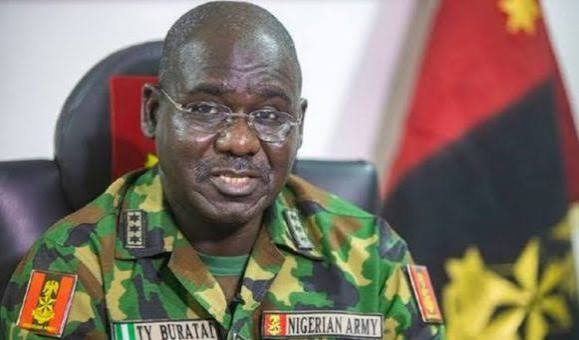
Former Chief of Army Staff, Lt. Gen. Tukur Buratai (rtd), has dismissed the belief that security agencies are incapable of locating bandits and kidnappers who openly circulate videos and communicate from their hideouts.
Buratai, who also served as Nigeria’s ambassador to Benin Republic, argued that with existing capabilities, authorities have what it takes to trace criminal elements if there is full determination to do so.
His remarks come amid rising concerns over recent abductions in parts of the country, including the kidnapping of pupils and teachers in Oyo State, where a teacher was later killed by the abductors.
Speaking during an interview on TVC on Monday, the retired army chief expressed doubt that security operatives truly lack the technical ability to track such criminals, especially in an era where they publicly showcase their activities online.
According to him, if security agencies can identify and monitor ordinary citizens and social media users, then it should not be difficult to locate armed groups who frequently post videos and boast about their operations.
While he did not directly accuse the agencies of incompetence, he suggested that operational considerations or internal reasons may sometimes influence how such cases are handled.
Buratai stressed that strengthening Nigeria’s security system requires continuous training, increased manpower, and improved welfare for personnel across all agencies.
He called for expanded recruitment into the military and police, noting that adequate staffing remains critical to addressing insecurity effectively.
He also emphasised the importance of regular retraining, better accommodation, and improved living conditions for officers and soldiers.
On counter-kidnap operations, Buratai explained that Nigeria’s armed forces possess specialised units capable of handling high-risk rescue missions.
He cited formations such as the Nigerian Navy’s Special Boat Service and the Nigerian Army Special Forces, noting that they are trained for hostage rescue and VIP protection duties.
However, he added that decisions in kidnapping situations are often guided by the need to protect victims and avoid unintended casualties, especially depending on the location and circumstances of the operation.
Buratai further urged the expansion of the National Counter Terrorism Centre under the Office of the National Security Adviser, saying enhanced coordination and technology would improve responses to terrorism and kidnapping.
He proposed establishing state-level branches of the centre equipped with modern facilities and command systems to strengthen collaboration among security agencies.
According to him, such decentralised structures would significantly improve intelligence sharing, operational efficiency, and overall national security response.