
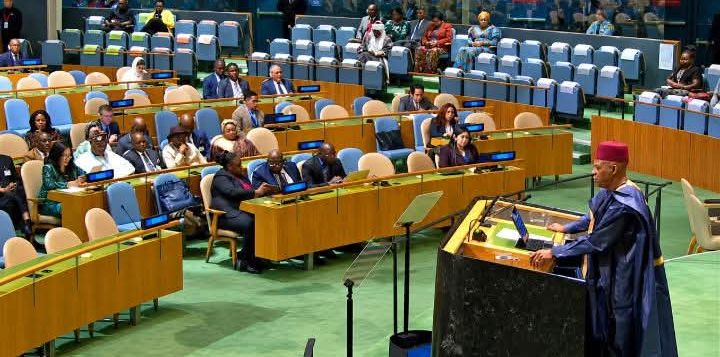
In a sweeping address to the 81st United Nations General Assembly, Nigeria’s Vice-President Kashim Shettima, representing President Bola Tinubu, issued a radical call to reshape global governance, demanding permanent African representation on the UN Security Council, a fundamental overhaul of climate finance, and a collaborative approach to the risks and rewards of artificial intelligence.
Speaking on Thursday, September 24, at the UN headquarters in New York, Shettima framed the present moment as a critical juncture where the institutions built for a world order long past must be reformed or risk becoming obsolete.
In the most forceful and recurring theme of the address, Nigeria demanded that the reform of the UN “must begin with the reconstitution of the Security Council” to grant Africa permanent seats.
President Tinubu, through Vice-President Shettima, argued that the world of 2026 cannot remain captive to the distribution of power established in 1945. “Africa cannot continue to fill the Council’s agenda while remaining absent from its permanent membership,” Shettima declared, questioning how a continent so central to global security debates is excluded from its most powerful decision-making body.
Backed by the Ezulwini Consensus and the Sirte Declaration, Nigeria is demanding at least two permanent seats for Africa, complete with all the rights and responsibilities of permanent membership, “including the veto for as long as it exists,” and a total of five non-permanent seats.
“The authority to speak for humanity carries an obligation to represent it,” Shettima stated, adding that Nigeria “stands ready to assume greater responsibility on the strength of obligations honoured and sacrifices made over decades”. He pointed to Nigeria’s extensive peacekeeping and mediation efforts in Liberia, Sierra Leone, Darfur, Mali, and The Gambia as evidence of its commitment to global security.
The Nigerian call to action has found powerful echoes. UN Secretary-General António Guterres earlier described Africa’s absence from the Council’s permanent membership as “unjust and indefensible”. Kenyan President William Ruto also renewed the call, stating emphatically that “Africa cannot be shut out” of the body.
Shifting from global governance to the climate crisis, Shettima rejected what he termed a “false choice between development and climate action”. He argued that developing countries must be allowed to industrialise, eradicate poverty, and expand energy access through low-carbon pathways, supported by technology transfer, capacity building, and robust climate finance.
“Africa contributes less than four per cent of the greenhouse gas emissions, yet we have disproportionate consequences,” he noted, highlighting the continent’s minimal contribution to a crisis it suffers from disproportionately.
Central to his address was a call for a restructuring of the global financial architecture. Shettima insisted that climate finance must be “governed by equity and shared responsibility, rather than charity”. He urged that international commitments be translated into “accessible, predictable, and adequately funded mechanisms” that do not force developing nations to compromise their development objectives.
Reaffirming Nigeria’s commitment to the Paris Agreement, he outlined the country’s Energy Transition Plan, which targets net-zero emissions by 2060 while aiming to expand access to affordable and reliable energy.
On the issue of emerging technologies, Shettima offered a nuanced perspective, steering clear of both alarmism and naive optimism. He described artificial intelligence as a tool whose impact depends entirely on human intent.
“We can deploy artificial intelligence to wage war or use it to transform healthcare, education, agriculture, governance, and economic productivity,” he told world leaders.
He cautioned against letting fear dictate policy, stating, “We refuse to surrender our technological future to paranoia”. Using a striking metaphor, he added, “A knife can take a life in the hands of an assailant and save one in the hands of a surgeon. An invention can be destructive or beneficial, depending on the purposes it serves and the judgement of those who use it”.
Shettima linked much of the anxiety surrounding AI to a breakdown of global trust, saying, “Much of the anxiety surrounding AI reflects the distrust we have allowed to grow among us”.
To harness AI’s potential, he outlined Nigeria’s investments in digital public infrastructure, broadband connectivity, and innovation systems. In a direct appeal to the international community, he invited the world to “work with our inventive, resourceful, and enterprising young people to direct AI towards humanity’s advancement rather than its destruction”.