
By Emmanuel Awari–Jalingo
The Taraba State Government has denied claims by the opposition that the state currently has a debt burden of about N1.2 trillion, saying the figure does not reflect its officially recognised debt stock as contained in the latest publicly available records of the Debt Management Office (DMO).
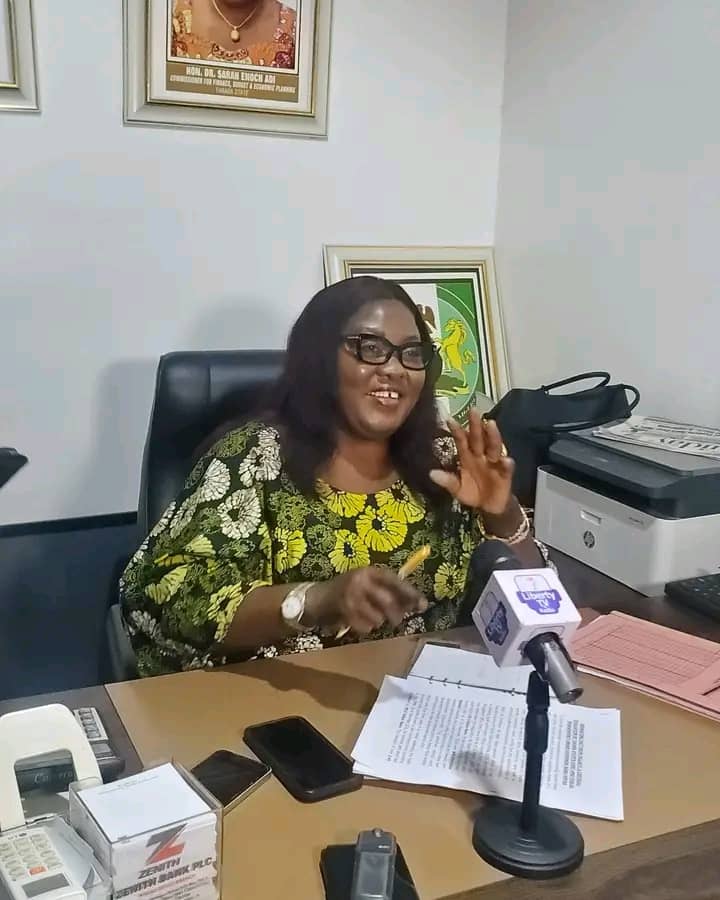
Reacting to the allegation, the Commissioner for Finance and Economic Planning, Dr Sarah Adi Enoch, said Taraba’s domestic debt stood at N85.51 billion as of December 31, 2025.
She said the figure represented a reduction of about N2.45 billion from the approximately N87.96 billion reported before the administration of Governor Agbu Kefas came into office.
She explained that the DMO had clarified that the Taraba debt figure contained in its March 2023 publication was based on the state’s position as of September 30, 2022.
According to the commissioner, the latest DMO data showed that Taraba’s domestic debt stock as of December 31, 2025, stood at approximately N85.51 billion.
“The official DMO figures therefore do not support suggestions that Taraba State’s recognised domestic debt stock has risen to anything approaching N1.2 trillion,” she said.
On the state’s external debt, Enoch said the DMO had placed Taraba’s external debt at approximately $46.47 million as of December 31, 2022, compared with $48.04 million as of December 31, 2025.
She described the movement in the external debt position as relatively modest, while acknowledging the exchange-rate risks associated with foreign-currency obligations.
Enoch said the state would continue to ensure that external financing remained within the limits of fiscal sustainability and its repayment capacity.
On the controversial N206.78 billion commercial bank facility, she explained that the Taraba State House of Assembly approved the financing facilities in 2023 involving Zenith Bank Plc, United Bank for Africa Plc, Fidelity Bank Plc and Keystone Bank.
According to her, the facilities were structured against designated revenue streams, including Federal Account Allocation, Joint Account Allocation Committee (JAAC) proceeds, Value Added Tax (VAT) receipts and Internally Generated Revenue (IGR).
“Governor Agbu Kefas has only collected N206 billion from commercial banks, and we are about to complete the repayment. So, people should stop listening to politicians who are misleading citizens about the debt profile of Taraba,” she said.
She cautioned politicians against equating the original approved facility value with the state’s current outstanding liability.
“Approval or original facility value is not the same thing as the outstanding liability at a later date, as repayments and restructuring have taken place under the facilities,” she said.
Enoch argued that it would be misleading to add the entire N206.78 billion approved in 2023 to the latest DMO debt stock without establishing the actual amount drawn, repayments already made and current outstanding balances.
“The State Government has continued to honour its repayment obligations in accordance with the applicable financing arrangements,” she said.
On the proposed N350 billion capital-market programme, the government clarified that Taraba had not received N350 billion under the proposed bond programme.
According to the commissioner, the programme remained subject to applicable regulatory, statutory, market and disclosure processes and was designed to enable the state to raise funds in stages, depending on approvals and prevailing market conditions.
She pointed out that the immediate transaction under consideration was an initial tranche of approximately N35 billion.
“It is therefore incorrect to treat the entire N350 billion programme size as money already received by the State or as an existing drawn liability,” she added.
The Finance Commissioner also addressed three financing agreements totalling approximately $268 million signed between Taraba State and the ECOWAS Bank for Investment and Development (EBID) on June 26, 2026.
Enoch disclosed that the financing package was intended to support the first phase of an integrated industrial park, the development of irrigated rice production and processing, and a 50-megawatt solar power project in the state.
She stressed that the signing of financing agreements should not be confused with the actual disbursement of funds.
She said the administration of Governor Agbu Kefas remained guided by three principles: borrowing that supports measurable development, repayment capacity and transparency and accountability.
According to her, financing undertaken by the state must be linked to productive infrastructure, economic expansion and improvements in the welfare of the people, while revenue projections, debt-service obligations and the sustainability of the state’s finances would be considered before new liabilities were assumed.
“Government will continue to comply with legislative, regulatory and disclosure requirements applicable to public borrowing and capital-market transactions,” she said.
She added that the Taraba State Government welcomed scrutiny but insisted that such scrutiny must be based on facts.
“The proper questions are not simply the headline amount of a proposed facility, but: How much was approved? How much was actually drawn? How much has been repaid? How much remains outstanding? What has not yet been disbursed? What projects are being financed? And what is the State’s repayment capacity?”
The commissioner reaffirmed the Taraba State Government’s commitment to responsible financing, disciplined debt management, transparency and the prudent use of public resources for the development of the state.