
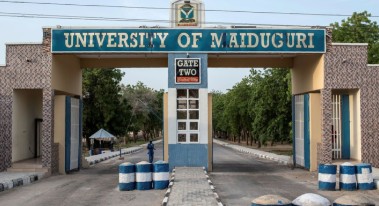
The Vice-Chancellor of the University of Maiduguri (UNIMAID), Muhammed Mele, has urged alumni of the institution to provide stronger financial, intellectual and professional support to sustain its growth and academic excellence.
Mr Mele made the call at the university’s first Global Annual Reunion Dinner and Awards Night, organised by the UNIMAID Alumni Association in Abuja.
He said the university’s continued development required more than government intervention, adding that alumni must take greater responsibility for funding, institutional development and the preservation of its legacy.
The vice-chancellor urged graduates, irrespective of their professional positions and locations, to reconnect with their alma mater and contribute meaningfully to its advancement.
“Let us build UNIMAID so that it can continue to strengthen our beloved nation, Nigeria,” he said.
Mr Mele said the institution had produced graduates making significant contributions across government, corporate organisations, security agencies, educational institutions and international organisations.
He described the alumni as ambassadors of the institution’s values and academic tradition, adding that their achievements reflected the quality of education and training received at the university.
“Wherever our alumni go, they carry the touch of UNIMAID with them, and they do that with unmatched distinction,” he said.
He said the institution’s ability to withstand years of difficult circumstances, particularly the challenges of insurgency and insecurity in the North-East, demonstrated the importance of collective commitment to its survival and development.
Mr Mele acknowledged the support of the federal government, President Bola Tinubu, who is the university’s Visitor, Borno Governor, Babagana Zulum, other state governors, members of the National Assembly, development partners and traditional rulers.
He, however, said alumni support remained essential to consolidating the gains recorded and sustaining the university’s pursuit of excellence.
The vice-chancellor also commended Vice-President Kashim Shettima for his leadership and contributions to national development, particularly his role in mobilising support for the successful relaunch of the university’s endowment fund.
Congratulating the award recipients, Mr Mele urged the alumni to see the reunion as an opportunity to renew their commitment to the institution rather than merely reminisce about their university days.
“Let us see this night, not just as a night to wine and dine and remember our days on campus, but also a night for all of us to renew our sacred past,” he said.
Earlier, the global president of the UNIMAID Alumni Association, Baba Shettima-Kukawa, said the association had registered nearly 10,000 graduates through its newly established online portal.
Mr Shettima-Kukawa described the database as the largest assembly of the university’s alumni records in its history.
He said the digital platform had also enabled the association to conduct its first nationwide online election, covering the entire process from the declaration of interest by aspirants to the announcement of winners.
According to him, the initiative was part of efforts to build a transparent, inclusive and sustainable alumni structure capable of maintaining continuity despite changes in leadership.
He also said the association was developing a scholarship endowment fund, mentorship programme and professional development board to support students and graduates.
He expressed optimism that the initiatives would become operational before the end of the year, saying they were designed to strengthen the relationship between the university and its graduates while creating opportunities for younger members.
In his keynote address, the president of the Worldwide University of Lagos Alumni Association, Ifeoluwa Oyedele, identified institutional resilience, leadership continuity and structured mentorship as critical to building effective alumni associations.
Mr Oyedele described the UNIMAID Alumni Association as a community that creates lifelong relationships, shared values and a common identity.
He commended UNIMAID for maintaining its presence in Maiduguri and sustaining academic activities despite the devastating effects of insurgency and insecurity in the North-East.
He said the university’s decision to remain open demonstrated the determination of its management, staff, students and alumni.
Mr Oyedele said the university’s experience offered important lessons on resilience, institutional commitment and the need for alumni to support their institutions during periods of adversity.
He said alumni associations risked losing institutional memory and developmental momentum without effective leadership succession arrangements.
He urged the association to establish structures that would guarantee the continuity of programmes beyond the tenure of individual executives.
“There is a need for structured mentorship programmes to help younger graduates navigate unemployment, economic uncertainty and professional development challenges.
“Stronger connections between older graduates, undergraduates and current students will enable alumni associations to mobilise their collective intellectual, professional, financial and social resources for institutional advancement.
“Unity among alumni does not require uniformity of opinion; members can disagree on issues and still remain committed to a common institutional purpose,” he said.
The reunion had the theme, “Unity, Resilience and Impact: Building UNIMAID, Strengthening the Nation”.
It brought together graduates and other stakeholders to celebrate the university’s achievements, honour distinguished alumni and discuss strategies for strengthening its future.
(NAN)