
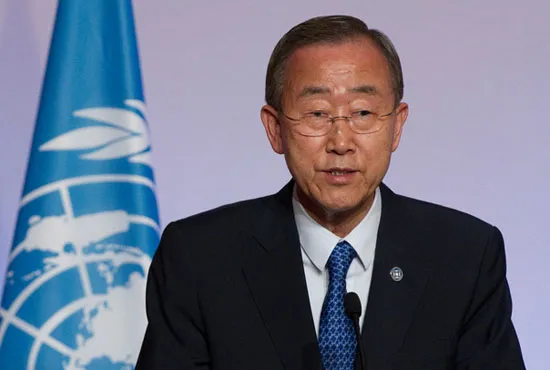
Former UN secretary-general Ban Ki-moon has challenged the Security Council to look backwards, despite deep rivalry and distrust, and urged it to choose leaders capable of steering the world away from catastrophe towards active cooperation.
The call came during an open debate on ‘Leadership for Peace’, where Mr Ban and academic Anjali Dayal pressed members to confront both the external crises facing the UN and internal constraints that have weakened its ability to act.
Mr Ban called on the Security Council to reform the use of the veto and to renew its support for UN leadership, saying they are essential if the organisation is to remain relevant in the 21st century.
“The path of each for themselves is no different from the path of mutual destruction,” he warned.
Mr Ban, now an emeritus member of The Elders group, warned that global conditions have worsened since he left office at the end of 2016, marked by deepening confrontation among major powers, eroding multilateralism, and conflicts in which civilians continue to pay the highest price.
“This deeply disappointing situation is characterised by confrontation rather than cooperation among major powers,” he told the council, citing the war in Ukraine, mass civilian casualties in Gaza and weakening international cooperation, even as the global climate crisis accelerates.
The former UN chief said the overall crisis cannot be separated from the Security Council’s own failures.
“The Security Council’s ongoing failure to properly function constitutes the most egregious cause,” he said, highlighting the repeated use of veto by permanent members “to shield themselves, their allies and their proxies from accountability”.
Without meaningful reform, Mr Ban warned, civilians will remain unprotected, and impunity will persist.
“Without it, the UN risks lurching towards either collapse or irrelevance,” he said.
Turning to the selection of the next secretary-general, Ban called for a single, non-renewable, seven-year term to strengthen the office’s independence.
The current practice of two five-year terms, he said, leaves Secretaries-General “overly dependent on this Council’s Permanent Members for an extension”. even though the arrangement is a convention rather than a requirement of the UN Charter.
“The General Assembly holds the power to set the terms of the appointment itself,” Mr Ban noted, urging member states to use that authority to empower the next UN leader more fully.
Secretary-general Antonio Guterres’s second term expires at the end of next year, and the formal selection process is already underway.
In November, the presidents of the General Assembly and the Security Council launched the process together, in line with General Assembly resolution 79/327, which highlights transparency and inclusivity.
(NAN)